Untethering
A dying senator, the meaning of life, and the three principles every self-help book keeps rediscovering

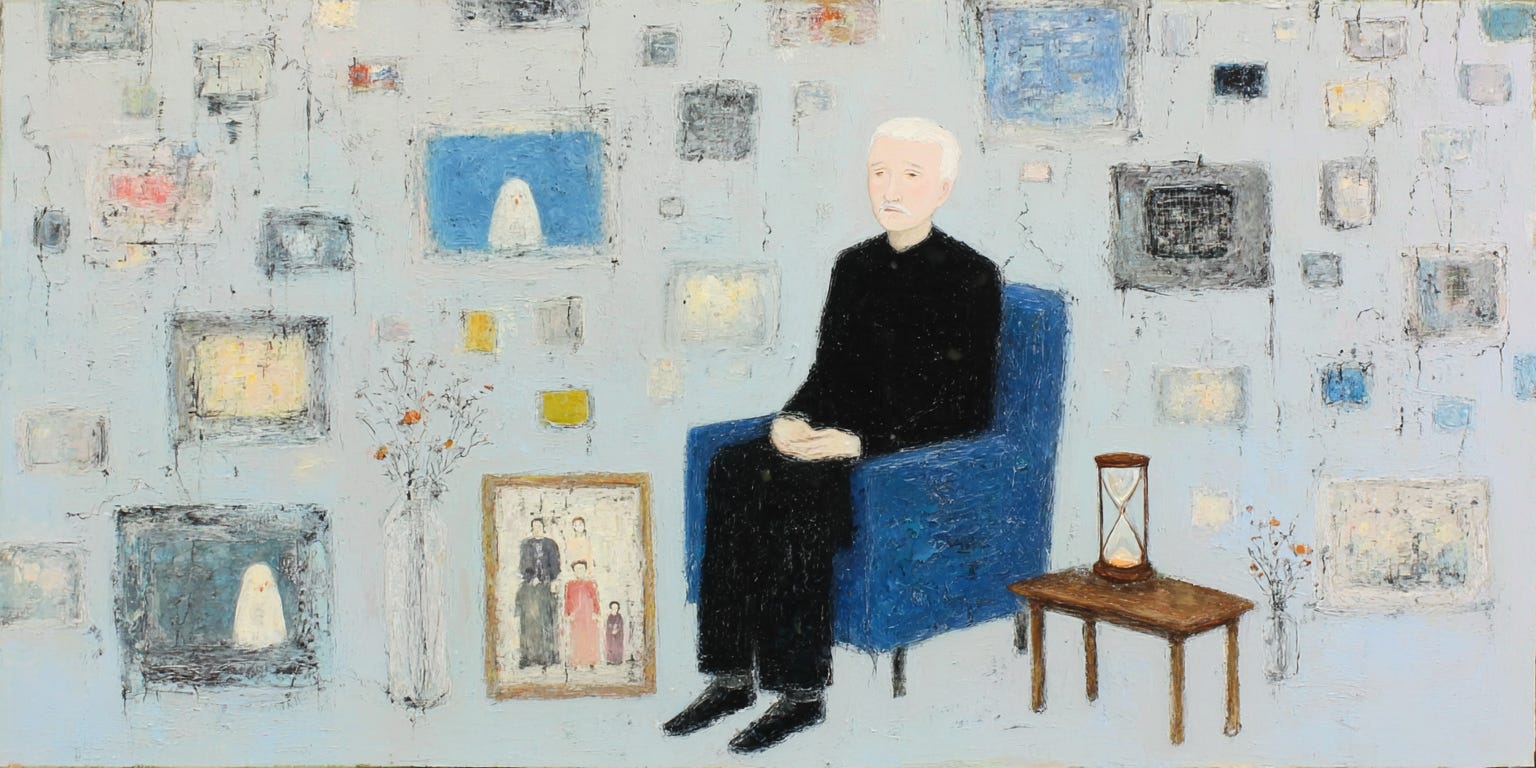
We Are All on the Clock
Last week, a lot of us were moved by a 60 Minutes interview with Ben Sasse, the former U.S. senator from Nebraska. Sasse is 54 years old and dying of pancreatic cancer. A clinical trial has given him extra time, and with that time he is doing something rare in public life: speaking plainly, decently, and without any obvious need to win something.
There is something clarifying about a person who no longer has much use for performance. Sasse is not running for office. He is not positioning himself for cable news. He is not trying to win the next round of whatever stupid fight happens to be consuming Washington this week. For 40 minutes, he seemed like something exotic in modern public life: a serious person, thinking out loud, presenting a clear and cogent vision of what might be.
“We’re all always on the clock,” he says, “some of us just have the benefit of knowing our time is finite.” The thing we all know but rarely appreciate. We are moving through a finite life inside a world designed to make us forget it: refreshing, reacting, performing, confusing stimulation for meaning and politics for community. Sasse’s gift was its simplicity. He evokes a return to first things: family, friendship, faith, and the basic question underneath all serious wisdom: how should we live?
Through the Looking Glass
Sasse’s makes the case that politics are but an echo of a more fundamental breakdown. Our communities are thin. Our institutions are distracted. Our attention is shattered. In 2023, the U.S. Surgeon General declared loneliness a public health crisis.
The same pattern is present across the rest of American life. Suicide rates rose over 30% from 2000 to 2022. Even sex, the most basic form of embodied human connection, is receding. A recent analysis suggests sexlessness among young adults rose from 9% to 24% for men and from 8% to 13% for women between 2013–15 and 2022–23.
And at precisely the moment we are most fragmented, we are living through a technological disruption that will fundamentally alter the structure of modern society. Anything that can be reduced to steps (most economic activity), will become routinized, cheap, fast, and ubiquitous.
Now more than ever, we need an alternative. Some belief system, or religion, or set of values, that can guide us out of the short-termism that plagues us and towards a transition to something better, calmer, more present, more optimistic, and more coherent.
Ancient Melodies of the Future
The funny thing about self-help: it’s all basically the same and none of it is new. It is old wisdom in new packaging. Sometimes beautiful. Sometimes strange. But beneath the branding, it’s always some version of the same claim: your identified reality is illusory, your consciousness matters, and you will live best when aligned with something larger than the ego.
Read The Power of Now by Eckhart Tolle: you are not your thoughts, life only happens in the present.
Read The Untethered Soul by Michael Singer: you are not the voice in your head, freedom begins when you stop identifying with every passing thought, fear, and reaction.
Read The Gap and the Gain by Dan Sullivan and Benjamin Hardy: stop measuring your life against the imagined future you have not yet reached.
The language is modern, but the ideas echo ancient spiritual traditions: Buddhism’s attention to craving and awareness, the teachings of Jesus on love, humility, and forgiveness, and the recurring mystical intuition that there is a deeper order beneath the noise of the mind.
Be Here. Be Thankful. Build.
Different versions of the same thing. Be present. Be grateful. Hold a vision. Detach from compulsive thought. Believe your actions matter. Stop measuring yourself against an imagined future. Build anyway. The language changes, but the structure underneath is remarkably consistent.
At the root all of this circles three basic principles: presence, gratitude, and creative ambition. Or, more simply: be here, be thankful, build. You need all three. Presence without ambition can become withdrawal. Ambition without gratitude becomes desperation. Gratitude without vision becomes complacency. Vision without presence becomes anxiety. The work is holding all three at once.
Be here. Be thankful. Build.
Be Here
In The Untethered Soul by Michael Singer explains you are not your mind. You are the thing listening to your mind. It’s one of those ideas that made me put the book down. Totally obvious and completely destabilizing. Compulsive thinking can become a disease: the voice in your head is a virus feeding on incessant thought.
But it isn’t you. It is a constructed thing. A pattern machine. Presence is what interrupts it. Presence is the moment you realize you are not your thoughts, you are the one observing your thoughts.
From Buddhism to Christ to Jon Kabat-Zinn to IFS, the vocabulary changes but the instructions are consistent: come back to reality. Come back to this breath, this body, this moment. Without that capacity, you are not fully living. You are being operated.
Be Thankful
If presence is the discipline of attention, gratitude is the discipline of orientation. It is a decision, about what kind of world you choose to inhabit. Henry Ford supposedly said, “Whether you think you can, or you think you can’t, you’re right.” The same is true of luck, abundance, possibility, and grace. If you believe the world is hostile, scarce, and conspiring against you, you’re right. I’m sure of it. If you believe the world is generous, mysterious, and filled with opportunity, you will find evidence for that too.
This is why gratitude is vital. It is the closest emotional posture to faith. Wallace Wattles understood this in The Science of Getting Rich. In his language, gratitude brings the mind into closer harmony with the creative power of the universe. Put differently, gratitude is the emotional frequency most aligned with abundance.
Build
Presence and gratitude are not enough. You can’t just sit quietly, observe your thoughts, and appreciate the birds, although honestly, good start. A lot of us could use more sitting quietly and more birds.
But human beings need direction. We need a future. We need something to build. This is the part of self-help represented by Wattles, Hill, and all the definite-aim literature. Some of it has been abused by prosperity hucksters and LinkedIn mystics, but the underlying principle is real. Without a chosen future, you get assigned one by the algorithm.
Self-Determination Theory argues that human flourishing depends on autonomy, competence, and relatedness: the feeling that we can choose, that we can grow, and that we are connected to other people. That is a more academic way of saying something ancient: people need agency, mastery, and belonging. Creative ambition is what happens when agency and mastery are pointed toward something worth building.
The Failure of a Society Without the Three
What does a society look like without presence? It looks like ours. Distracted. Reactive. Unable to sit with complexity long enough to understand it. Moving from outrage to outrage with the attention span of a caffeinated squirrel trapped inside a casino.
What does a society look like without gratitude? Again, ours. Perpetually dissatisfied. Richer than any civilization in human history and somehow convinced that everything is deprivation. Surrounded by miracles and trained to notice only relative disadvantage.
And what does a society look like without creative ambition? Cynical. Short-term. Nasty and brutish, if not short. Completely focused on securing the bag. A whole culture optimized for immediate stimulation and poorly organized for meaning.
Untethering
We are living through an age of acceleration. AI is coming for the routines. The algorithms are coming for the attention. Politics is coming for the identity. The market is coming for the ambition. The answer cannot simply be to opt out. Our job is to live here, in this world, with these tools, these temptations, and these responsibilities.
This is why the old practices survive: Sabbath, prayer, family dinner, worship, neighborhood, table fellowship. They are technologies of attention and belonging.
That is what made the Sasse interview so moving.
Not the politics Or the warnings about technology.
The love.
A husband preparing to leave his wife behind.
A father who wants to walk his daughters down the aisle.
A dad who wants to put his arm around his son and watch his shoulders get taller.
That is the center.
The people.
The family.
The life directly in front of you.
Be here.
Be thankful.
Build.
Ben Sasse is dying, which means he is saying what he believes while there is still time.
The rest of us do not need a diagnosis to listen.
We are all on the clock.
The work is to live like it.
Next Week
Community Part Deux: The Return of Community: In an age of digital slop, we will see deeper entrenchment around in-person communities. But what are the secrets to building one? Each community is a set of beliefs about the world and about the people that join.
Also On My Mind
A few other things on my mind. Let me know what else you might like me to write about.
A great brand is willing to be different. To be different, you have to take risks. To take risks you have to be willing to piss some people off. Or be weird. But that’s what wins in this world. So do you have the cojones?
I was on a run today with my friend Vincent who mentioned that everyone that wants to do a hard pivot underestimates the time it takes. Never pivot away from something that is clearly working.
Thanks for reading.
Sam
PS “Sundays with Sam” comes out every Sunday. If you liked this, feel free to share it with a friend, completely rip off all the ideas and present them as your own, or reply to this email and say hi. I get all replies btw. If you like the pictures, use the Midjourney reference code --sref 87135456 to make your own. Unsubscribe freely for any or no reason.
Just what I needed to read this morning. Very well done, Sam.
Your most poignant and touching writing to date, Sam. It’s as if we share a brain, and maybe, in some way we do. I’ve always been a Benjamin Button in my mind, wise beyond my years, mature for my age, an old soul, as it were. A man out of place in both space and time. Born half a century too late. Or too early. Depending on how you look at it.
I love the associative nature of your mind, like mine, in detecting patterns across history and synthesizing the tasseled fragments into a tapestry uniquely its own.
Life is too short, as many over the ages have inadequately expounded. As a journalism major in college I wrote a column about happiness and the meaning of life in the our daily student newspaper, the Diamondback, at the University of Maryland, College Park.
It was the most well-received article I’ve ever written in my life. Because it struck a chord that resonated with every student on campus and every person who had ever walked this Earth. The eternal human struggle for meaning. I described the meaning of life as “how we spend our time, in what manner and with whom.” A very journalistic answer in its Who, What, Why, When and How” of its simplicity. The inverted pyramid applied to the very essence of life itself. In the style of The Wall Street Journal’s oft-imitated, seldom-repeated opening graph of personal human interest stories first before bridging to the meat of the story.
The longitudinal Harvard Happiness studies all tell us the same thing. About the deepest regrets of the dying. And what it means for a life well lived.