Sundays with Sam #29: Theories of Everything
On astrology, Demis Hassabis, the nature of time, and the search for God

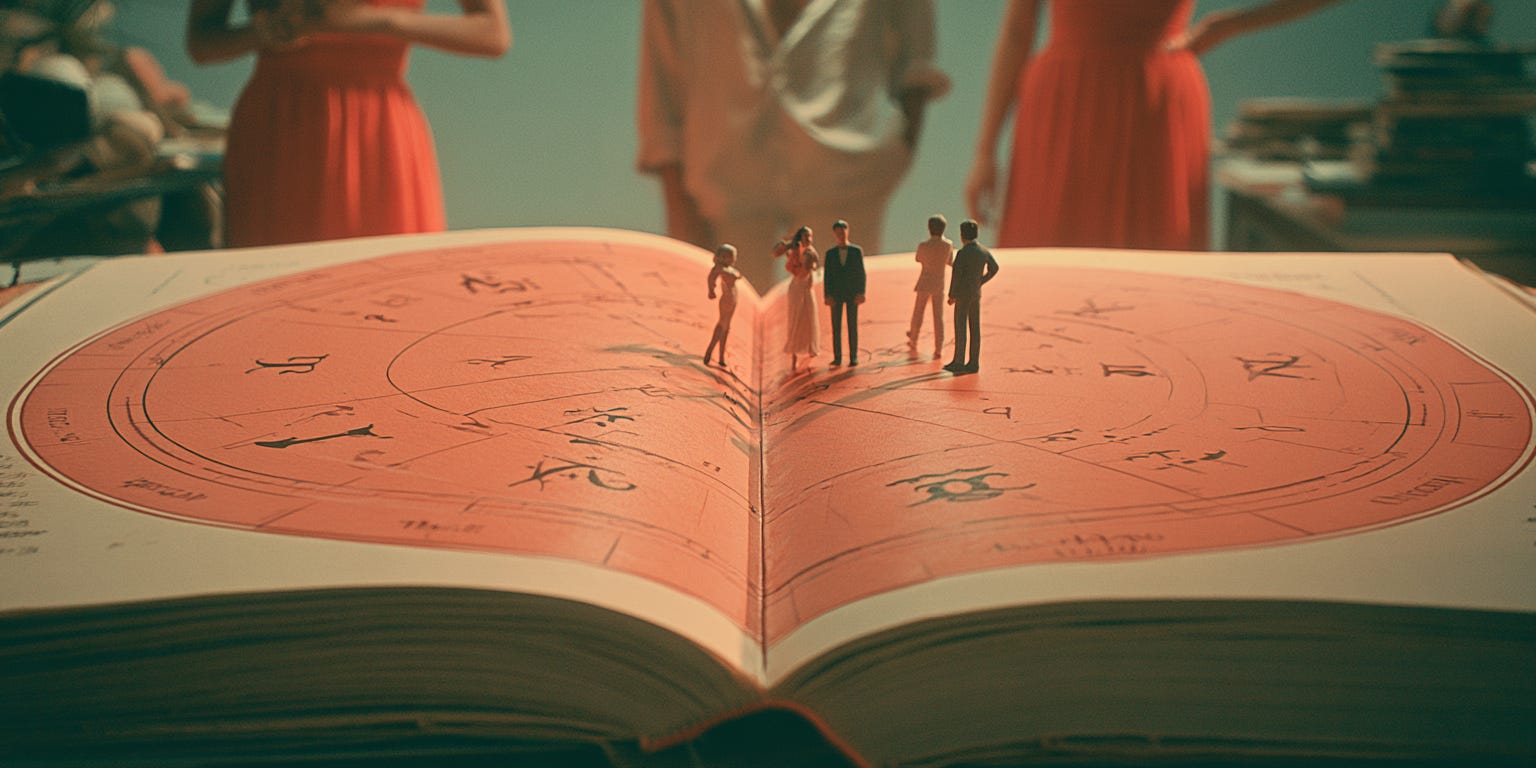
How Soon Is Now?
A few years ago, several members of my family visited an astrologer. She wasn’t the sort who trafficked in vague personality traits or conveniently broad predictions. She produced five-year outlooks with specific months and years attached to major life events. Among other things she predicted my wife and I would have a child, a baby girl, long before any of that seemed possible or likely.
Months later, after a routine prenatal appointment in Lyon, I remember sitting in the backseat of the Uber with two completely contradictory thoughts lodged in my mind. The first was a strange certainty that everything had already been written. All of life had happened. God was real and understood everything about me. Had already seen and known everything I’d done or would ever do.
The second was that somehow this changed absolutely nothing about free will. Despite everything having already been written, we still made choices and those choices rippled through time like waves on a lake.

Time
One of the books that gave me a language for thinking about that afternoon in Lyon was Carlo Rovelli’s The Order of Time. Like most people, I had always assumed that time was a fundamental feature of reality, a universal clock steadily ticking from yesterday through today toward tomorrow. Physics has spent the last century dismantling that intuition. Einstein showed that time is relative rather than absolute. Since then, physicists like Rovelli, Julian Barbour, and Sean Carroll have pushed the conversation even further, asking whether our experience of time reflects the underlying structure of the universe at all.
One interpretation of modern physics invites us to imagine reality less as a film being projected frame by frame and more as a landscape that exists in its entirety. Past, present, and future are no longer separate places waiting to come into being, but different regions of the same terrain, with our experience of “now” arising from the particular path consciousness takes through it. Rovelli argues that time may emerge from deeper physical relationships rather than existing as one of the universe’s fundamental ingredients. Barbour has spent decades advancing the provocative idea that the universe is ultimately timeless, with change creating the illusion of temporal flow. Carroll approaches the question from yet another direction, arguing that our experience of time’s relentless march is intimately connected to entropy.
They disagree on the mathematics, yet all arrive at the same unsettling realization: the intuitive picture of time we’ve inherited is nearly impossible to defend.
Thinking Stuff
In 1910, while Albert Einstein was laying the foundations for what would become general relativity, Wallace Wattles was writing a very different tome: The Science of Getting Rich. A book that would eventually become one of the foundational texts of the modern manifestation movement.
At the heart of Wattles’ philosophy is an idea that sounds hopelessly mystical: the universe is made of “thinking stuff.” Every building, company, invention, and work of art first existed as an idea before it became physical reality. Human beings participate in creation by directing their thoughts toward a vision and then acting upon it within the constraints of the physical world. Manifestation, in Wattles’ telling, wasn’t magic. It was the disciplined act of conceiving something that did not yet exist and then bringing it into existence through sustained thought and action.
A century later, the language has changed. But the idea of manifestation is a stubborn thing and persists in different forms. Physicists debate whether information is more fundamental than matter. John Wheeler famously wondered whether reality itself might be understood as “It from Bit.“ Artificial intelligence reduces language itself into patterns of information that can be represented, transformed, and reconstructed.
Where Is My Mind?
For most of the twentieth century, consciousness occupied an uncomfortable place in science. Neuroscience became extraordinarily successful at explaining the brain but failed to explain why this particular collection of atoms and molecules should produce experience at all. This is what philosopher David Chalmers famously calls the “Hard Problem”: Why does the universe experience? The experience to see the color blue, to hear a symphony, fall in love, or stand beneath a sky full of stars?
One response is straightforward but radical: panpsychism. The simple idea that consciousness is a fundamental feature of reality itself, woven into the fabric of the universe in much the same way that mass, charge, or space-time are. If consciousness is fundamental, there is no 0 to 1 leap where a pile of carbon, hydrogen, and oxygen suddenly becomes Sam. Instead, the experience of Sam, of humans, or dogs, or trees, or rocks, emerges and compounds in certain critical combinations.
For centuries, mystics described a universe infused with mind, with spirit, with a kind of magic that they called God. Then, later, scientists gradually and deliberately convert these mystical ideas into technical documentation, into the language of physics and matter, equations and formulas.
Each tribe assumes they are presenting a clear prima facie description of the world. Each are actually discovering another face of the same mountain whilst giving it a different name.
Altered Beast
When I finally picked up The Infinity Machine, I expected to read the history of DeepMind and the race to build artificial intelligence. Instead I found myself reading a book about humanity. Demis Hassabis has had one clear ambition his entire career: to understand intelligence so completely it can be recreated.
The moment you embark on that journey, you inevitably collide with questions that have occupied philosophers, theologians, and mystics for thousands of years. What is intelligence? What is consciousness? Where does creativity come from? What, exactly, are we?
At this point, I hope these questions are starting to sound familiar.
Every year another supposedly unique human capability becomes, if not solved, at least reproducible. The mechanism becomes clearer and the mystery moves one level deeper. Explaining how neurons fire only serves to make consciousness more extraordinary. Understanding stellar evolution deepens the experience of standing beneath a sky full of stars. The closer science gets to explaining intelligence, the more remarkable intelligence itself begins to appear.
That, I think, is why so many seemingly unrelated conversations are now converging. Artificial intelligence is forcing computer scientists into philosophy. Neuroscience is forcing biologists into theology. None of these disciplines set out to rediscover mysticism. They simply followed their own questions as far as they could, and, yet, somewhere along the way, found themselves in remarkably familiar territory.
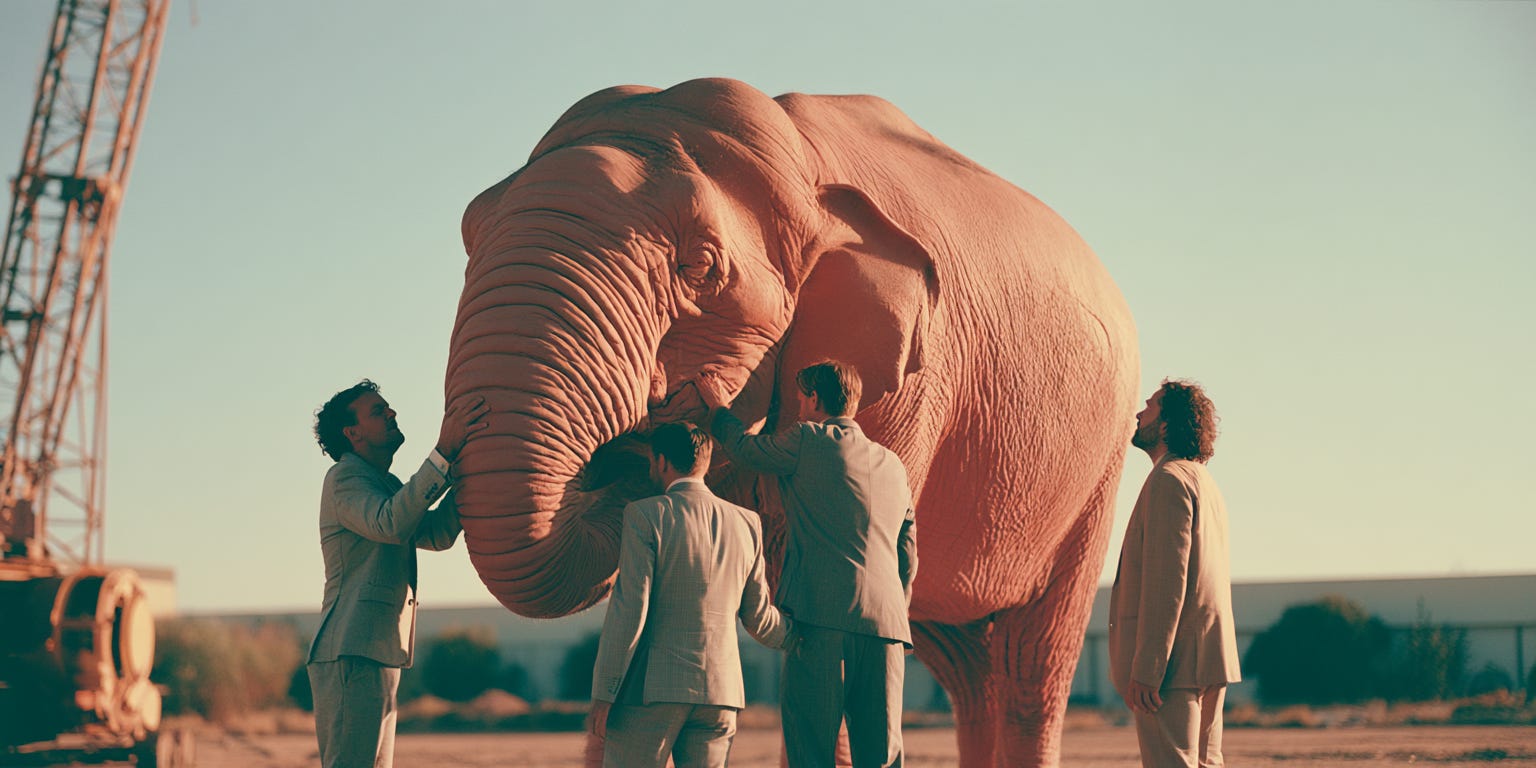
Tusk
There’s an ancient parable about several blind men encountering an elephant for the first time. One feels its trunk and concludes an elephant is like a snake. Another embraces its leg and insists it is a tree. A third presses against its side and describes a wall. Each has discovered something true yet their mistake lies in believing that the part they understand is the whole.
We now possess astonishingly detailed descriptions of how modern AI systems work. We understand transformer architectures, attention mechanisms, embeddings, gradient descent, and the mathematics that allow these systems to learn.
These formulas and descriptions are mechanistic. By solving the equations we imply there is something less than about the intelligence that we’re building. As if we understand intelligence in the first place.
But we don’t.
We don’t even understand ourselves.
Neuroscience can describe neurons and synapses with extraordinary sophistication. We can increasingly explain how the human brain processes language, stores memories, and makes decisions. Yet if I replaced the words “transformer” and “attention layer” with “neuron” and “cortex,” we would still arrive at exactly the same unanswered question. We speak confidently about artificial consciousness while remaining profoundly uncertain about our own.
The farther science advances, the more complete its descriptions become, and the more obvious it becomes that descriptions alone cannot settle the fundamental questions. Physics. Neuroscience. Biotech. AI. Each achievement reveals another piece of the elephant. None persuades me that we’ve finally encountered the whole animal.
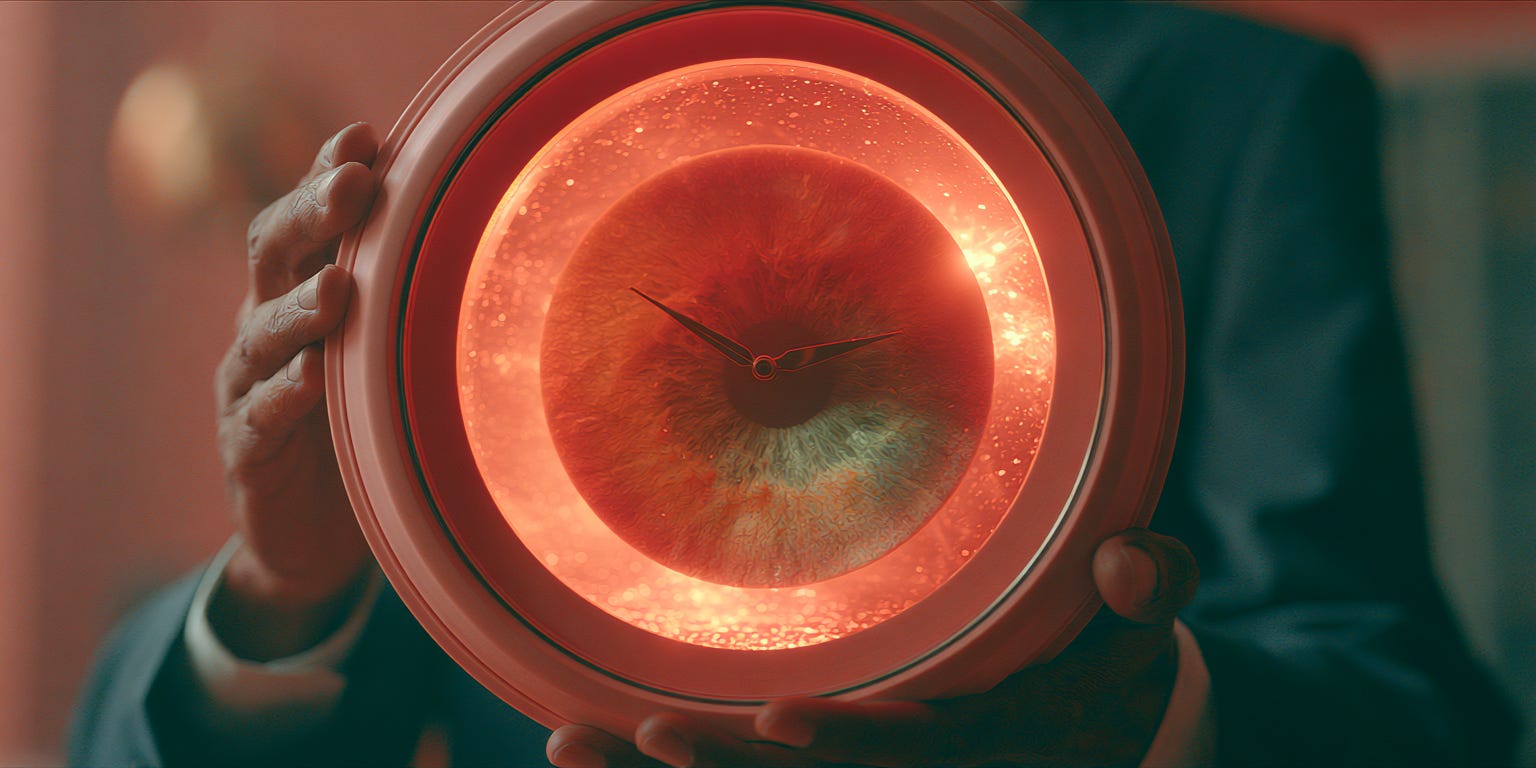
Theories of Everything
I still think about that afternoon in Lyon.
At the time I had no language for what I was feeling. Today I have physics, philosophy, neuroscience, artificial intelligence, and a shelf full of books that all attempt to describe reality through different methods. Oddly enough, the more I read, the more that feeling seems like an intuition waiting for its vocabulary.
I suspect the next century will continue doing what the last one did so brilliantly. We’ll discover deeper equations, better models, and increasingly elegant descriptions of reality.
I also suspect we’ll keep making the same mistake. We’ll confuse the description for the thing being described. We’ll derive another equation and conclude that the mystery has disappeared.
When the mystery was never hiding inside the mathematics to begin with.
The mystery has always been here.
In consciousness itself.
In the astonishing fact that the universe is aware.
In the experience of standing beneath the stars.
Holding your daughter, falling in love, sitting quietly in meditation, or feeling, however briefly, that you are participating in something immeasurably larger than yourself.
Something suffused with love and awe and spirit.
Over the next hundred years, scientists and philosophers and mystics are going to keep climbing until they discover they’ve been tracing different routes up the same mountain.
When they reach the summit, I think they’ll discover the only possible answer is one that brings them all together, the math of life and the wonder of life coexisting and integrated. Science and God under the same firmament. As they have been all along.
Next Week
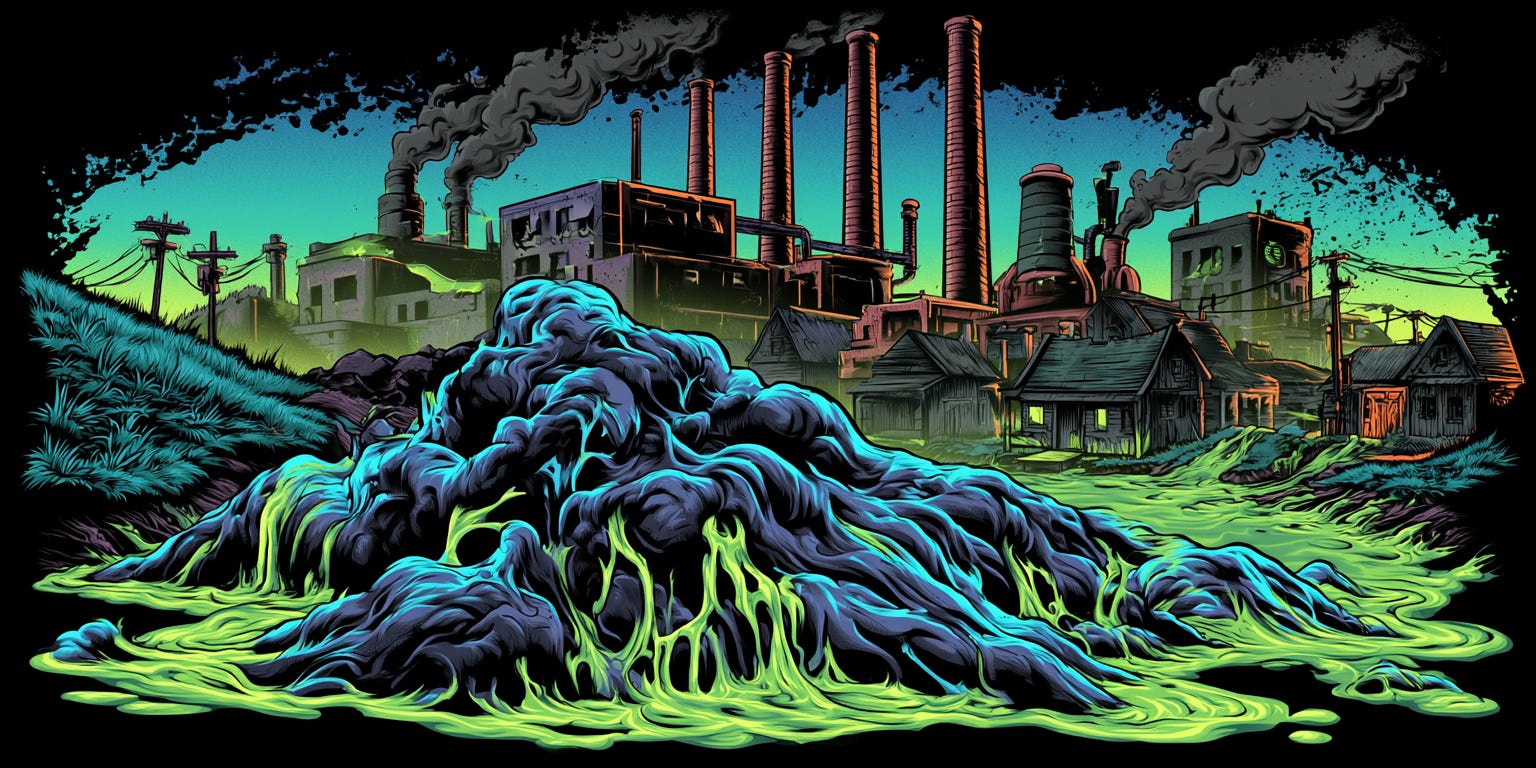
Sloppy Metaphors. Is writing with AI like McDonald’s? Cheap, satisfying, and vaguely unhealthy. Is it like IKEA? Modular, democratized and Scandinavian. Is an auto-generated LinkedIn comment counterfeit currency? Food photography? Spam? Something else entirely? Our increasingly desperate search for metaphors to describe writing and communication, each of which hints at a truth without fully capturing it.
Announcements & Noteworthy Happenings
We’re launching small mastermind groups we call Small Councils as part of a new super-secret membership tier. 8-10 non-competitive in-seat operators at the same stage of growth, led by an incredible moderator, meeting 1-2x per month to from the critical personal board of advisors you’ll need to navigate the new world. Existing Members will receive a significant discount to be part of the Founding Cohort. Reply to this email if you want to learn more.
Join us in New York at the end of September for our annual GTM event. You’ll meet Geoffrey Moore, author of Crossing the Chasm. Nick Mehta will be there. As will about 1,000 other leading CMOs, CROs, CEOs, and Investors all discussing the future of GTM. We’re close to selling out so reserve your ticket here.
Also On My Mind
A few other things on my mind. Let me know what else you might like me to write about.
The frontier labs are doing everything they can to scare the hell out of us so the government will regulate away their competition particularly when it comes to China. But who said being a frontier lab is a business model that needs help? If AGI is like nuclear weapons, it should be owned by the government. And if it’s not, it should have to compete in the marketplace of ideas. I’m on Team Gurley for this one.
Elon’s interview with the Economist is a Rohrscach test designed to confirm your priors. In our household, we are pro-abundance and pro-human. We support spreading consciousness to the stars. We have no opinion on the safety of London but haven’t heard great things from people that live there. If that triggers you, I’m sorry. Let’s break some bread and look each other in the eyes.
Thanks for reading.
PS “Sundays with Sam” comes out every Sunday. If you enjoyed this essay, please click Share and add your thoughts here, on X, or on LinkedIn. If you like the pictures, use Midjourney reference code --sref 509447060 to make your own. Unsubscribe freely for any or no reason.
From a young age, I felt the need to understand the universe around me. I stumbled upon the term “Natural Laws”, not knowing philosophers like Aristotle and Cicero argued that a higher, unchanging law of nature binds all of human society.
I cannot agree more with: the math of life and the wonder of life coexisting and integrated. Science and God under the same firmament. As they have been all along.
An unexpected and refreshingly new take on AI and all our theories on everything. Also, want that astrologers name... ♐️