Sundays with Sam #22: Moatlessness
On castles, ChatGPT, Real Madrid, and why every competitive advantage is collapsing

The Real Madrid Debate
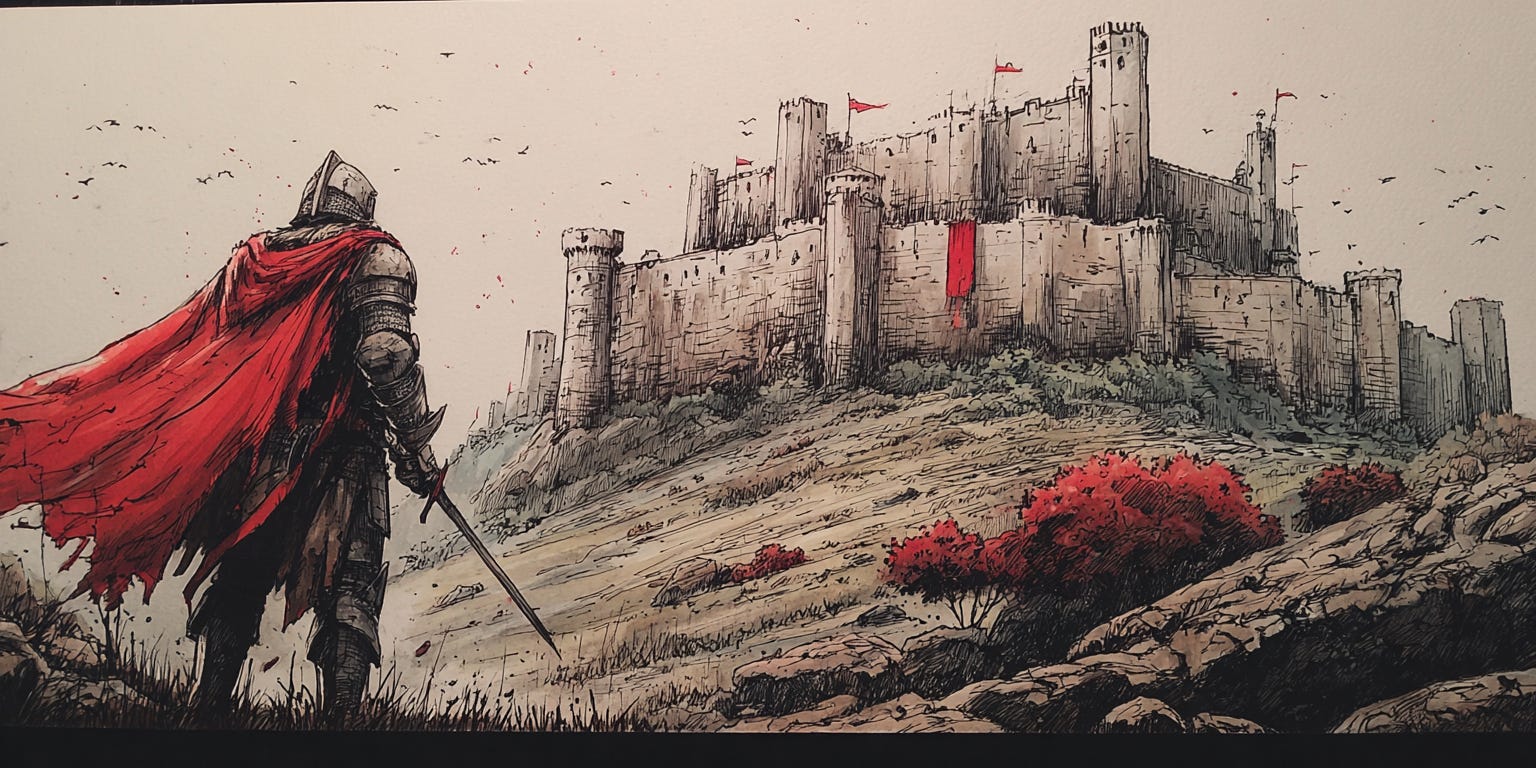
On a recent episode of Topline, Asad and I got into a debate about moats. The question was whether, in a world where product advantages disappear quickly, execution itself can become a moat. If the cost of software goes to zero and anything can be copied nearly instantly, maybe the only defensible strategy left is to stay one step ahead forever.
He brought up Real Madrid. In football, there is no permanent patent. Every season begins again. Every advantage decays. And yet Real Madrid is Real Madrid. Its value comes from the repeated ability to stay ahead. From years of sustained excellence that evolve into a self-reinforcing institution.
Color me skeptical.
When I hear “staying one step ahead,” I do not hear a moat. I hear a treadmill. I hear a company waking up every morning with the same problem it had yesterday: keep running, keep shipping, keep hoping the competition does not catch up. That may be a strategy. But it does not sound like a moat.
A moat, properly understood, is not merely an advantage. It is an advantage that endures. It is a structure that protects future cash flows from competition. It is defensibility that functions while you sleep. Some structural fundamental piece of your business that prevents people from simply taking what you’ve spent years accumulating.
Understood that way, execution is not a moat. Execution is simply the table stakes of building a business.
Distribution Is Not a Moat Either
Meanwhile, last week my friend Max and the team at GTMFund published an essay arguing that we have entered “The Distribution Era.” The thrust is that as software becomes easier to build, product becomes less defensible, and distribution becomes the new moat. I understand the appeal of this idea. Go-To-Market matters as much as it ever has. But distribution is also not a moat.
Distribution can mean almost anything. Sometimes it means paid acquisition. Sometimes it means a founder’s LinkedIn following. Sometimes it’s simply the fact that people have heard of you.
Those are not all the same thing and, more importantly, they are not permanent structural advantages. In fact, the actual job is to convert short-term distribution advantage into long-term embedded advantage, such as brand.
Brand as accumulated trust and preference. Repeated exposure can create familiarity. Familiarity can create trust. Trust can lower the cost of future growth.
In that sense, distribution can help build a moat. But the moat is not distribution but what it eventually creates: compounding belief, preference, and economic advantage. That you can’t steal overnight.
Winters of Claude
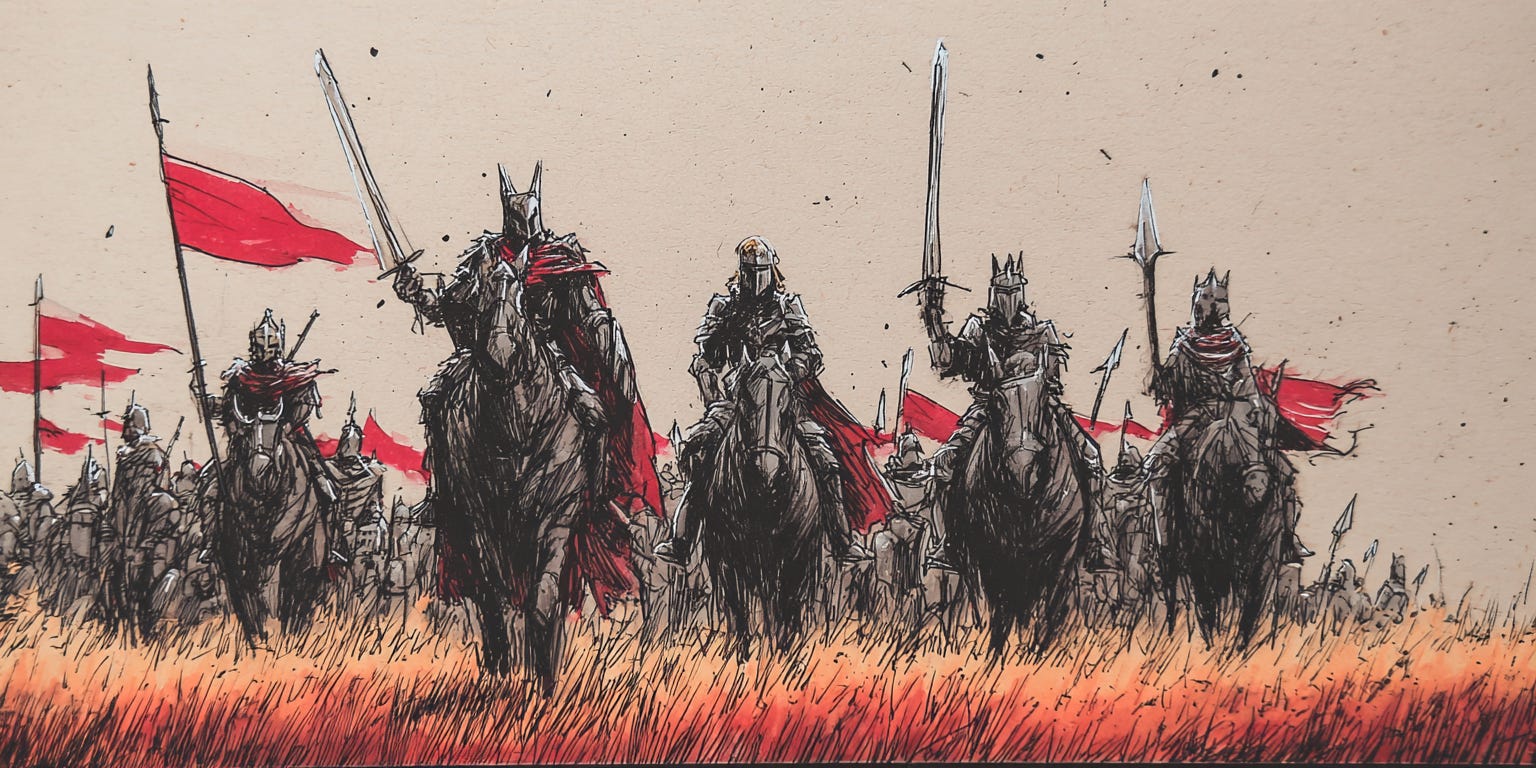
The problem with declaring that product no longer matters is that the fastest-growing companies in the world keep proving otherwise. Before November 2022, nobody had ever heard of OpenAI nor used any of their products.
Then they tried ChatGPT. The product was shocking. People told all their friends about it. The world caught fire. And everyone started using it. The product created the distribution.
The same is broadly true for Anthropic. Claude did not begin with massive consumer distribution. It grew exactly the same way. We had the Winter of Claude, CoWork was released and, in a span of just a few months, it overtook the incumbent in revenue, usage, and adoption.
Meanwhile, on the other coast, Ramp just announced another massive raise at a $44B valuation. But Ramp is competing in one of the world’s toughest categories. One where they were not first or even second to market but way back of the line. Expensify, Navan, Brex, and even RocketTrip all came before.
Ramp is winning on product excellence and execution. Which is not distribution. And is also not a moat.
No Retreat, No Surrender
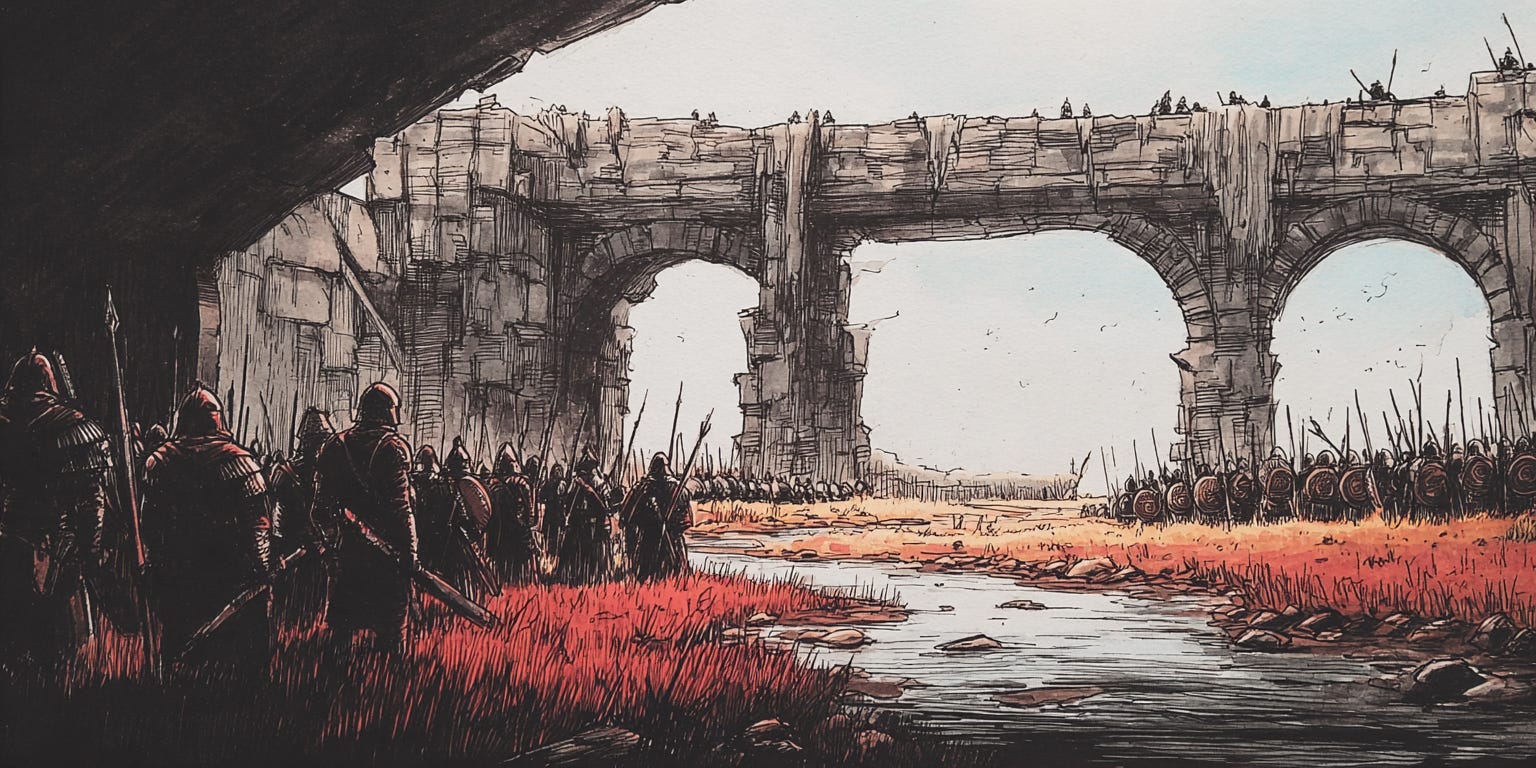
Long before stone fortresses and drawbridges, ancient settlements used ditches, earthworks, and natural terrain to make attack more difficult. The basic idea was simple: before an enemy could reach the thing you were protecting, force them to cross something awkward, exposed, and expensive.
The classic medieval moat emerged alongside the castle itself. Early motte-and-bailey castles often used a raised earth mound, timber or stone walls, and surrounding ditches. Water made the obstacle more difficult to cross, but even a dry ditch mattered. It made ladders less useful. It pushed siege engines farther from the walls. It forced attackers into more predictable and more exposed positions.
Did moats work? Yes, but not in the way people sometimes imagine. They did not make castles invincible. Instead, they changed the economics of attack. They bought time. They made certain tactics harder and others more dangerous.
The lesson for all of us in the modern era is simple. The moat is but one layer in a broader system of defense. A moat does not mean no one can compete with you. It means competitors pay a tax to compete with you. A moat is not “we are ahead.” A moat is “catching us is expensive.”
The Half-Life of Structural Advantage
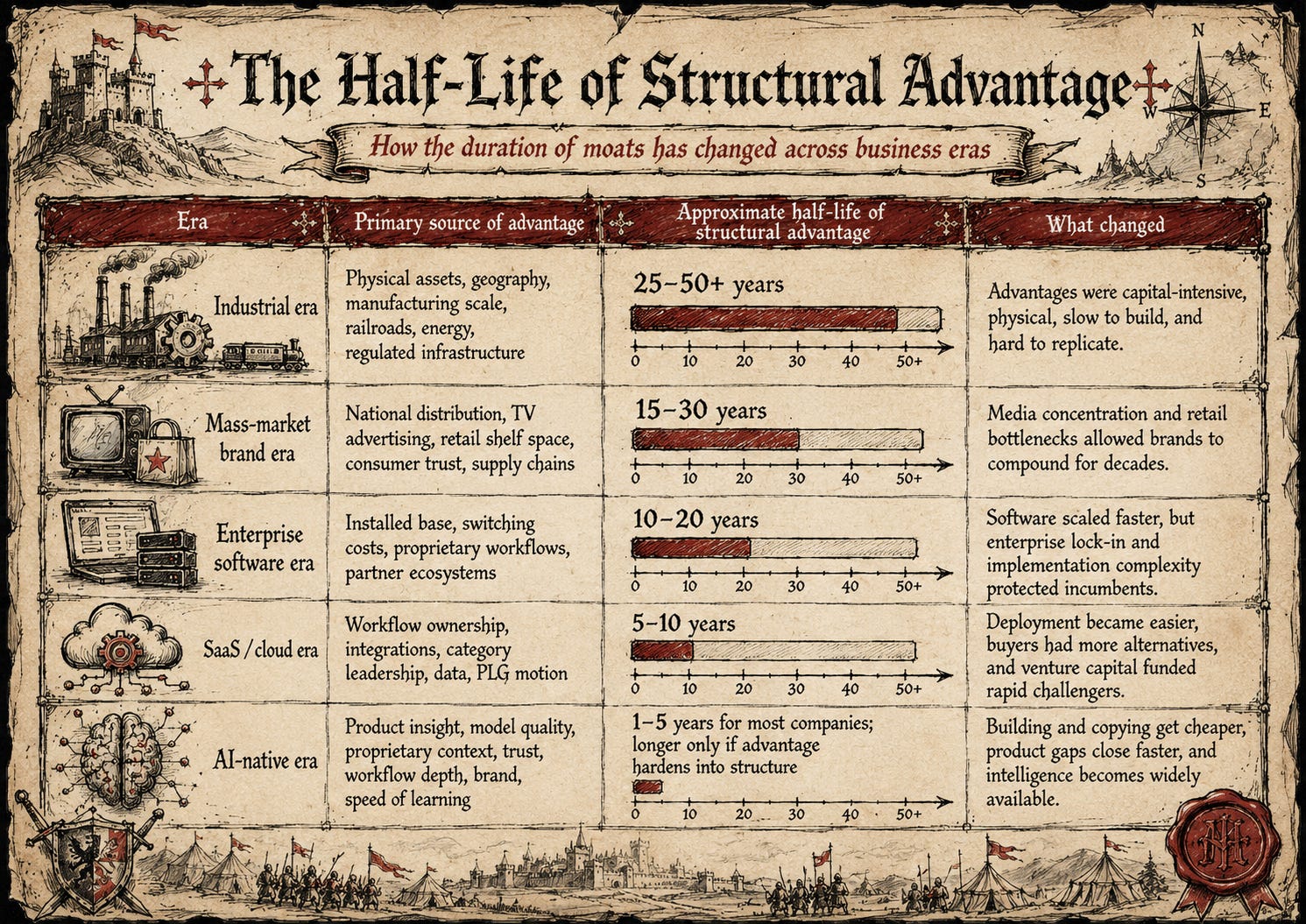
We live in a world of rapidly increasing change. A world where the relentlessness and speed of markets collapse long-term durable edge into something much shorter. The half-life of structural advantage measures that rate of collapse.
In the industrial era, structural advantages lasted for decades. If you owned a railroad, your advantage was capital-intensive and slow to replicate. Competitors could not simply wake up, raise a seed round, hire three engineers, and vibe code a railroad.
In the enterprise software era, installed base and switching costs protected incumbents. Nobody enjoyed ripping out core systems. Then came SaaS. Deployment became easier. Switching became easier. Categories proliferated. The moat did not disappear, but the half-life shortened.
Now comes AI and half-life compresses again. Building gets easier. Copying gets easier. The market becomes more competitively liquid.
With every new age, the duration of a moat decreases dramatically.
Whose Moat Is It Anyway?
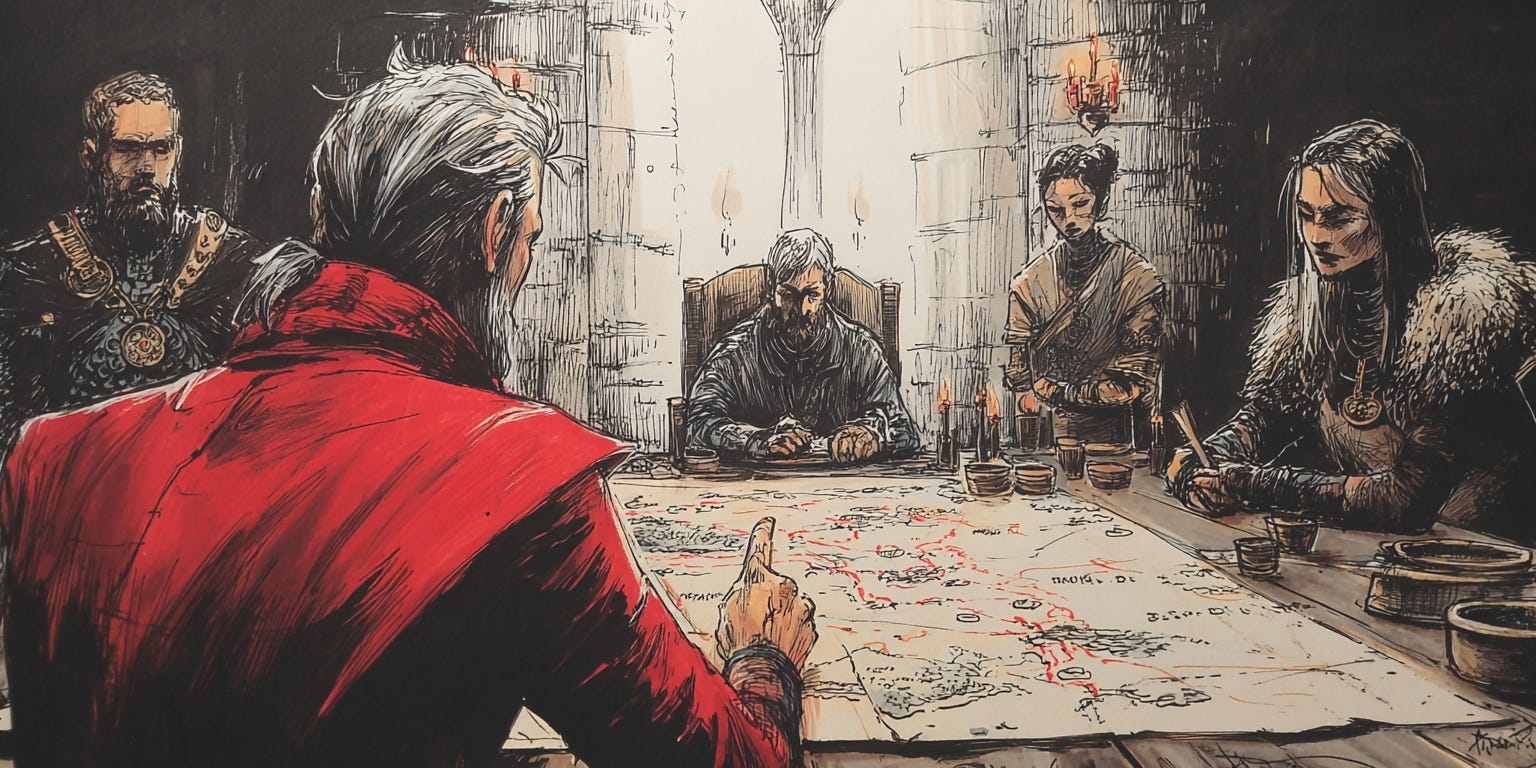
This does not mean moats are gone. It means we need to be more precise about what qualifies. A moat exists when a company has something that meaningfully increases the cost, time, or difficulty of imitation. Regulation, network effects, switching costs, brand, proprietary context, community, workflow ownership, and cultural status can all become moats, but only when they make a business harder to copy, harder to displace, or more expensive to compete against.
This is what Asad’s Real Madrid analogy gets right. Winning reinforces the conditions that make future winning more likely. The brand attracts talent. Talent wins more games. More wins create more revenue. The system compounds. Repeated performance hardens into structural advantage.
The same is true in business. If repeated execution creates a compounding structural advantage, a moat may emerge. If it means waking up every morning and sprinting harder, that is not a moat. That is cardio.
Conversion Rates
Moatlessness is not the same as defenselessness. The companies that endure will not be the ones that discover one permanent source of protection and hide behind it forever. They will be the ones that keep converting temporary advantages into more durable forms of protection before those advantages decay. In a world where moats dry faster, strategy becomes the work of constantly rebuilding them.
The mistake is believing that the first advantage is the moat. A great product is not a moat. Distribution is not a moat. Speed is not a moat. AI is not a moat. Each can create value, but each can also disappear. The real question is what the advantage becomes before the market catches up.
Moatlessness
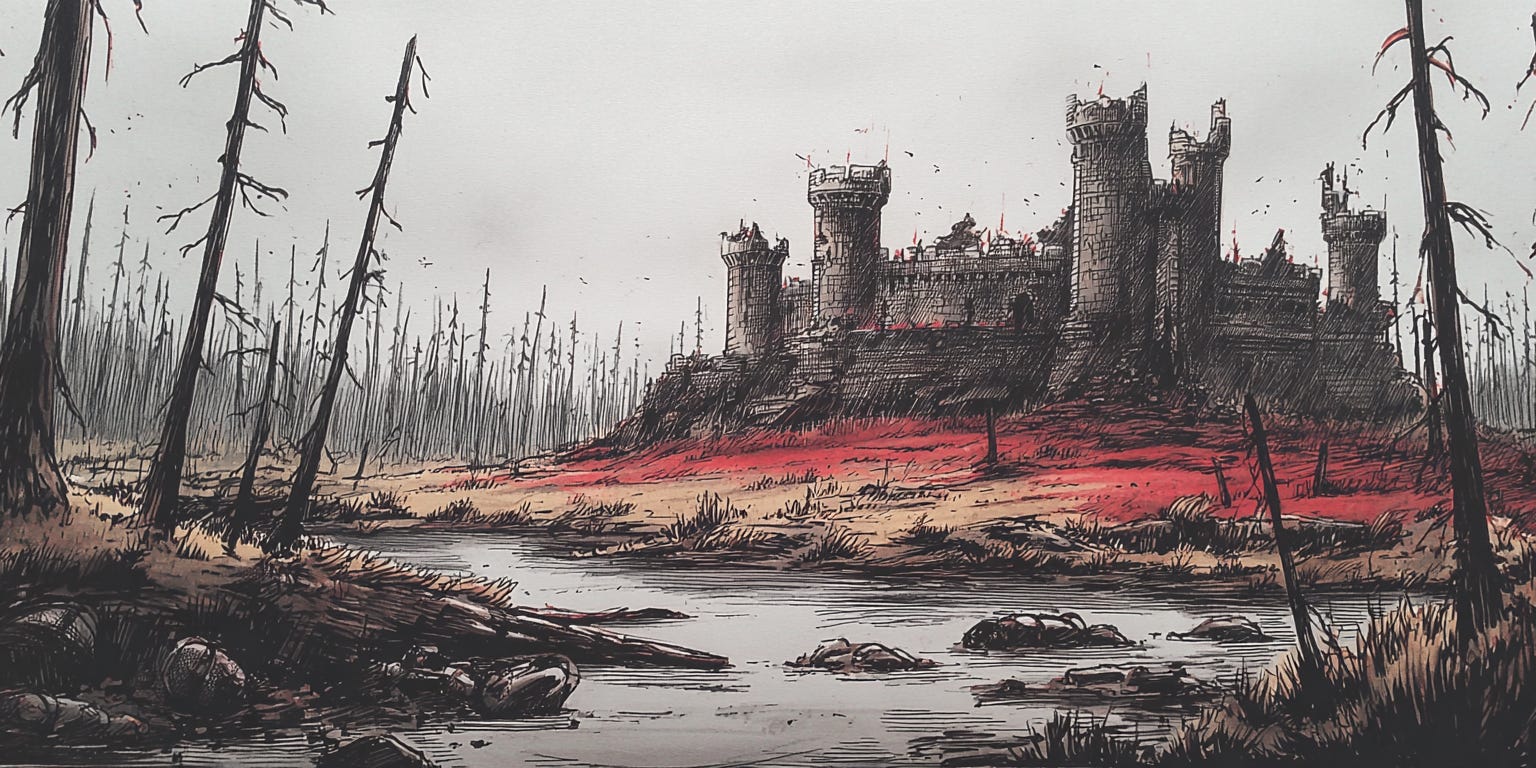
We are entering an age of moatlessness. The world is changing too quickly. The old world of building a moat, settling behind it, and compounding for decades is dead.
The Mongol hordes of relentless change are too creative to let us huddle safely behind the castle walls.
Product still matters. Only a truly great product can create its own gravity. Distribution still matters. Great products still need pathways to adoption. Execution still matters. The distance between insight and imitation is collapsing.
But none of those are enough by themselves.
The job of executives is to continually find ways to convert short-term advantage into structural separation.
To keep converting hard work, great product, distribution, and data into something that puts space, time, and money between you and your competition.
That is the difference between momentum and terminal value.
Momentum means you are ahead.
A moat means you are hard (and expensive) to catch.
The future belongs to companies that understand the difference.
Upcoming Travels and Notable Adventures
Me and Pavilion Gold head to Jackson Hole, Wyoming, for our first Summer Retreat. We’ve got the CEOs/Co-Founders of Dust, Nooks, and Vector, the amazing Brett Queener, the incredible Steve Rowland, and 20 other CROs and CMOs from $100M+ companies. June 9-12. I’ll send you some pics.
We’re collecting responses for the 2nd Pavilion AI Pulse Survey. The first one had a ton of interesting data discussing how organizations are implementing AI, what are best practices, and which tools and products are most widely adopted. Take it here if you have the chance.
Next Week

Attention Deficits. The biggest reason distribution is not a moat is this: if distribution means attention, attention decays faster and faster. There is no place — literally no place — where you can reliably and consistently reach the people you claim are listening to you. Nobody is paying attention and it means distribution isn’t quite the asset you thought it was.
Also On My Mind
A few other things on my mind. Let me know what else you might like me to write about.
Reading the Sebastian Mallaby book about Demis Hassabis and thinking about the pursuit of a theory of everything. Demis builds AI to better understand the universe. I personally have a theory of most things but I’m not a scientist nor a philosopher. Just a collection of beliefs that hold up to our increasing understanding of the way things actually operate.
What are the new jobs of the future. Tastemaker. Experimenter. Data collector. AI Ops. What else.
Thanks for reading.
PS “Sundays with Sam” comes out every Sunday. If you liked this, feel free to share it with a friend or hit Reply to this email. I’ll see it and will likely respond. If you like the pictures, use Midjourney reference code --sref 2110875693 to make your own. Unsubscribe freely for any or no reason.
Brand and IP have always been a company's moat. Now, as you point out since IP can be copied on a dime, it's less about IP and speed to market, and yet it is still about brand and distribution channels. But now I'd say that the moat of any SaaS company is squarely Brand + Data. That's the moat. Because the data feeds the AI models, without it, you look like everyone else in your category.