Introspection Antics
Marc Andreessen, Travis Kalanick, and the myth of the founder personality


An Absence of Introspection
Last week, everyone was talking about Marc Andreessen’s interview with David Senra through the A16Z podcast. The conversation turned to the psychology of entrepreneurs, and Andreessen made a claim that I (and many others) haven’t been able to shake. He suggested that many of the greatest founders have little to no introspection. In his and David’s telling, people like Sam Walton didn’t wake up wondering about their inner lives or questioning their identity. They woke up thinking about building Walmart, and then they built more Walmart.
He connected this to a personality trait psychologists call low neuroticism. The best founders, he argued, don’t get emotionally shaken by events. They don’t dwell on the past. They don’t spiral or second-guess themselves. They simply move forward. It’s a compelling explanation for how someone survives the volatility of building a company. If you are constantly looking backward, you never accumulate enough forward momentum to succeed.
At the same time, labeling all self-reflection as “bad” is on its face ridiculous. If introspection is detrimental to success, the qualities we associate with reflection, self-awareness, and internal questioning might actually be liabilities.
Going All the Way
Around the same time, I watched the Travis Kalanick interview on TBPN where he described Uber’s approach to fundraising during its hypergrowth phase. The process itself was extreme: multiple rooms running simultaneously, investors cycling through tightly scheduled slots, every part of the system optimized for maximum intensity. No sense of moderation. The entire approach was built around pushing as far as possible.
At one point, he used a metaphor that, as a runner, hit close to home. He described mile 21 of a marathon, the point where fatigue sets in and the real effort begins. Where people normally hit “the wall”. If someone is comfortable at that stage, he said, they are about to be passed by someone who wants it more. The people who win are the ones willing to endure more, to push beyond what feels reasonable, and to sustain that effort longer than everyone else.
When you put that next to Andreessen’s claim, a consistent picture emerges. The successful founder is someone who does not hesitate, does not reflect, and does not slow down. They combine emotional stability with extreme intensity and an unusually high tolerance for pain. They are willing to go all the way. Or die trying.

The Founder Archetype
Spend enough time around venture capital or startup media and this picture starts to feel like a rule rather than an example. The founder becomes a kind of archetype: relentless, forward-driving, emotionally imperturbable. Unconflicted. Complete confidence. Committed to the task and willing to push harder than anyone else. 9-9-6. Founder mode.
This archetype is reinforced by what we choose to highlight. The most visible founders are often the most extreme. Their stories are easier to tell, easier to admire, and easier to compress into simple narratives about intensity and willpower. Over time, those stories crowd out other ways of building.
The result: instead of asking what kinds of personalities can succeed, we assume that success only comes from one very specific type of personality. Everyone else can take a hike.
My Personal Mismatch
Here’s the obvious rub. I’m not like that. I’m reflective. I spend time thinking about decisions, revisiting assumptions, and trying to understand what I’m doing and why. That tendency doesn’t disappear when things get difficult. If anything, it becomes more pronounced.
My energy also doesn’t show up as a straight line. It comes in cycles. There are periods where everything feels clear and productive, followed by periods where I step back and reassess. It’s not paralysis, but it’s not the constant forward pressure that the archetype implies. It’s a different rhythm.
In the past, I would hear these stories of Elon, or Travis, or Sam Walton and I would do two things: First, yell at myself for not being more like the classic type and second, try halfheartedly to mold myself into something completely counter to my chemistry and personality. For better or worse, my output didn’t tend to improve.
The work becomes less natural, less interesting, and ultimately less effective. So maybe I’m not meant to be someone that Marc Andreessen rates highly.
Yet here I am, the CEO of a company. Pavilion is not the biggest company in the world. But we’re certainly the biggest GTM community. We have 10,000 Members and chapters all over the world. Clearly, I’ve been doing something over the last 10 years.
So then. The question becomes: is the archetype actually necessary, or just one of several ways to operate?
A Brief History of Personality
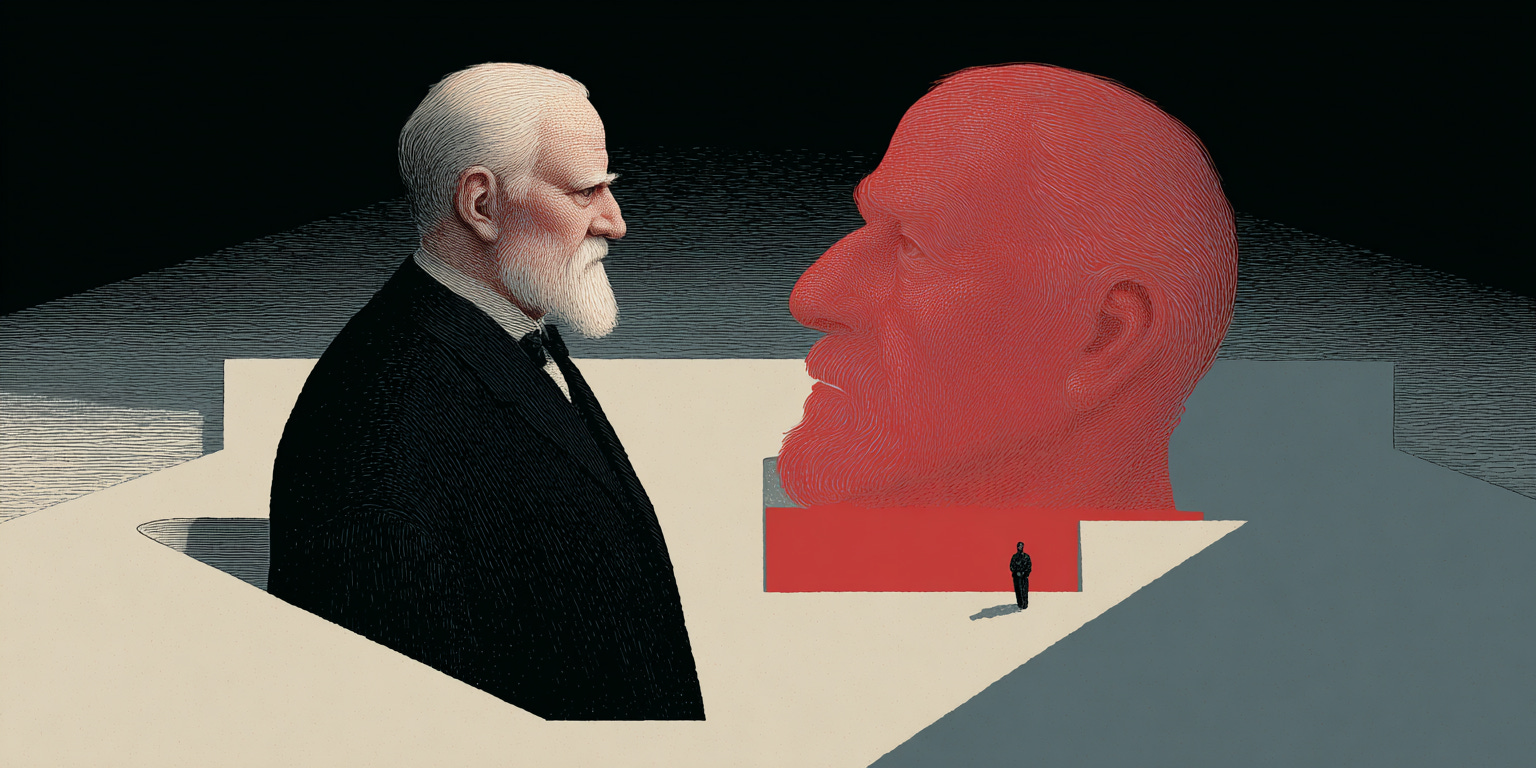
To make sense of this, it helps to step back and look at how we’ve historically understood personality. Humans have been trying to classify temperament for thousands of years. The ancient Greeks believed behavior could be explained through bodily humors: sanguine, choleric, melancholic, and phlegmatic. These early models were primitive, but they reflected a persistent instinct - we want to categorize human differences into something legible.
Interestingly, the Greeks were not saying all humors were equivalent. They were implicitly ranking them. The choleric temperament (decisive, aggressive, action-oriented) was associated with leadership, conquest, and power. The melancholic temperament, more reflective and inward-looking, was associated with philosophy and analysis. Useful, but secondary. Two thousand years later, that hierarchy feels familiar. The archetype Andreessen describes is a founder who simply acts, does not dwell, and pushes forward without hesitation. Which sounds a lot like a modern version of the choleric ideal.
In the early twentieth century, the focus shifted inward. Freud and the Vienna school introduced the idea that the internal life of the individual was central to behavior. Jung extended this into psychological types, which later influenced systems like Myers-Briggs. These frameworks placed introspection at the center of understanding human action. The self became something to analyze, interpret, and understand before acting.
Modern psychology has moved in a different direction. Instead of discrete “types,” it relies on trait-based models. The most widely accepted is the Big Five, which describes personality along five dimensions: openness, conscientiousness, extraversion, agreeableness, and neuroticism (McCrae & Costa, 1997). These traits are continuous, not categorical, and have been validated across cultures and large populations. At the same time, systems like the Enneagram have persisted because they offer a compelling language for internal motivation and identity.
In practice, one framework explains behavior statistically; the other explains how it feels from the inside. (I’m a true 4 if you’re wondering.)
Patterns in the Data
When researchers study entrepreneurs using the Big Five, some patterns emerge. Entrepreneurs tend to score higher in openness and conscientiousness, which aligns with curiosity, creativity, and sustained effort. They also tend to score lower in neuroticism, which suggests greater emotional stability under pressure. These findings have been replicated across multiple studies, including a widely cited meta-analysis by Zhao and Seibert (2006).
Large-scale studies of founder populations suggest that different traits may matter at different stages of building a company. For example, openness is associated with opportunity recognition and early-stage innovation, while extraversion and agreeableness can play a role in fundraising and team formation. Martin Obschonka has done extensive research to support the view that emotional stability (low neuroticism) has a profound impact on navigating volatility.
What is notably absent from the research, however, is any evidence that all successful founders share the same psychological structure. There is no universal template. Instead, there are patterns of traits that can combine in different ways to produce different kinds of outcomes.
Founder Taxonomies
If you take the Big Five seriously, a more structured view of founder personalities begins to emerge. Instead of a single archetype, you can think in terms of trait combinations that produce different operating styles. These are not formal scientific categories, but they are grounded in how traits cluster in practice.
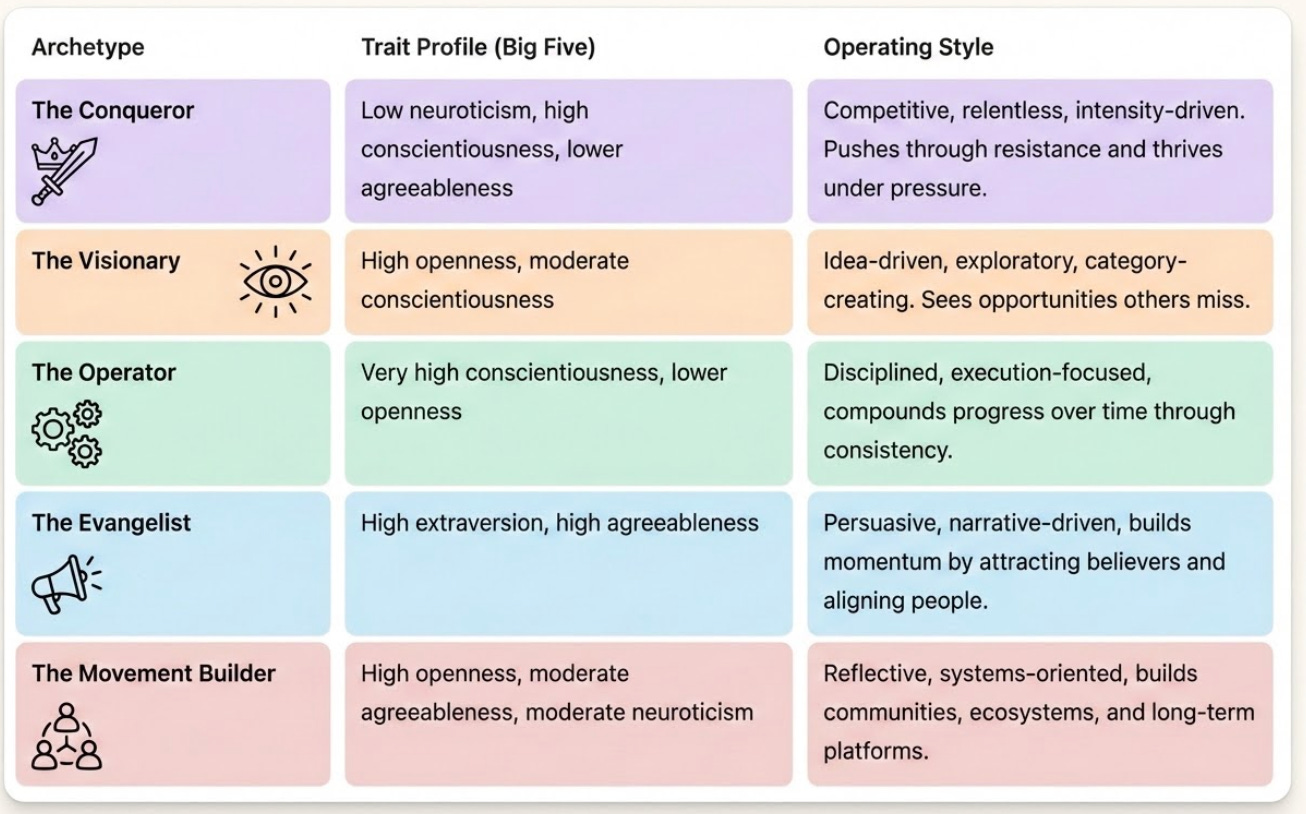
These archetypes are simply different configurations of the same underlying traits. The Conqueror aligns most closely with the archetype promoted in venture culture. Relentless, emotionally stable, and intensity-driven. But the others represent equally plausible paths, each with its own strengths and tradeoffs.
The important point is not which archetype is “best.” It’s that multiple configurations can produce meaningful outcomes.

Introspection vs Neuroticism
Andreessen’s argument becomes more precise when you separate two concepts that are often conflated. Neuroticism refers to emotional instability including anxiety, rumination, and reactivity. Introspection, by contrast, refers to the act of examining one’s own thinking, values, and decisions.
It is easy to see how excessive rumination can be harmful. Founders who get stuck replaying failures or second-guessing themselves may struggle to move forward. But that is not the same as reflection. Introspection, when used productively, is how people develop judgment and align their actions with their goals.
Many of the most consequential figures in history were deeply reflective. They did not lack introspection; they used it as a tool. The difference was that their reflection did not prevent them from acting. It informed their actions. The problem, then, is not introspection itself, but the inability to move beyond it.
Rationalizing Underperformance
There is a still more uncomfortable possibility underneath all of this. Namely, that I’m using all this research as justification to rationalize a personal limitation. That my discomfort with the dominant archetype is not about alignment, but about unwillingness or inability to operate at that level of intensity.
Maybe I’m just weak or mediocre.
The only way to address that possibility is through outcomes. A given way of operating has to produce results. It has to generate consistent, compounding progress over time. If it does not, then it is not a viable alternative. Personality does not exempt anyone from the requirement to perform.
At the same time, the nature of that performance can vary. Not every path requires the same kind of intensity or the same expression of effort. What matters is whether the chosen approach aligns with reality. Whether it respects constraints, incorporates feedback, and improves over time. Without that, any framework becomes an excuse rather than an explanation.

At Mile 21
Marathons, and their preparation, makes this distinction clear. The race does not respond to aspiration or identity. It responds to preparation, pacing, nutrition, and execution. You can set an aggressive target, but if it is not grounded in reality, the race will expose that quickly.
What I’ve found is that a more grounded approach, one that respects constraints and builds on experience, tends to produce better outcomes. For me, at least, that’s what worked last Sunday in Barcelona.
It may not be the most aggressive or the most dramatic, but it is more consistent. And in a long race, consistency compounds.
The same logic applies to building companies. There may be multiple ways to sustain effort, make decisions, and create value. It’s a mistake to believe there’s only one path to success, just as it’s a mistake to think a different temperament is inherently a flaw. The error lies in assuming a single winning formula.
The key however is to understand that the formula is likely alignment between the type of business you build and your personality archetype.
Which, I suppose, is a fairly introspective way to arrive at the conclusion that introspection might still be useful.
I guess me and Marc aren’t going to be friends.
Also On My Mind
A few other things on my mind. Let me know what you’d like me to write about
The debate right now is centralized vs decentralized AI. You want the better output of a centralized AI function with in production support. But you also want to let your best athletes run and build cool stuff.
The most active conversation about AI’s impact on Go To Market right now is inside Pavilion. We’re also launching a new AI Buddy program (build AI with someone else for accountability and faster learning), a new pulse survey, and of course our AI in GTM School launching soon. If you’re interested in knowing what’s going on as it happens, take a look here.
The podcast all of my friends are listening to this week is Ed Mylett’s interview with Mike Posner. It might be the message you need to hear right now. Beware: significant introspection awaits.
Thanks for reading.
Sam
PS If you liked this, feel free to share it with a friend, post it online, reply to this email and say hi. This newsletter comes out every Sunday. If you didn’t like it, unsubscribe freely. No hard feelings.
Love this post, Sam. I think it bears mentioning that venture capital's personality preference aligns with their risk profile. They are continually looking for a founder who will shoot the moon - lay it all out there - go for the 10x. I'm like you. My negative self-talk it is often about how I move too slow. But I've done a good job of staying alive, of protecting downside, of persevering through pivots and taking the time to solve hard problems. Good for you, VC, if you find another Travis. Those people are a high-risk high-reward bet.
Sam, this is one of the most thoughtful and timely articles on entrepreneurship I've read in ages. After 25 years running a B2B marketing agency for venture-backed tech companies as a solopreneur, I spent the last week exploring a hypothesis: would I be more effective or productive in how I work and make decisions if I filtered it through my personality (INFJ-A).
It started on a personal level, I applied my INFJ-A personality to a list of my Top 10 movies in ChatGPT to see if it would provide more relevant movie recommendations than Netflix and Apple. Not only did it work better, almost immediately, combining my psychology with my movie taste and underlying story structure and genres, it made me curious if the same process would yield insights in my business life running Everclear.
Not only was it successful, but it helped me understand that I'm hard-wired for deep thought vs. quick action. I process a lot of information across competitive markets, distill it, synthesize it and crystalize it for my clients for their positioning, messaging and branding. I align the strengths of their company with the market needs of its customers against the weaknesses of its competitors to achieve higher throughput for their GTM efforts to compound faster.
But this also means I suffer from analysis paralysis. I get stuck processing instead of taking action on those thoughts. That's my psychology pattern. But the barrier was simplifying the cognitive load of my decision making. If I could figure out what I need to make decisions faster, assemble that data first and make decisions faster, I could work "with" my brain instead of "against" it and not feel guilty that my brain works the way it does.
That insight was perfectly aligned with your newsletter this morning on a subject that is relevant not only to my solopreneur business personally but also to the entrepreneurial clients I serve daily. Thank you for connecting the dots for me and providing me with even more validation and permission to work the way I'm wired, even if its not the way others are wired.
I read very few of the newsletters in my Inbox each week, but your's stopped me dead in my tracks. I've been a big fan of yours for years, but have never joined Pavilion yet, but I didn't realize this was your newsletter before I started reading. If this is the level of insight you provide, I will make this a must-read every week.