Central Intelligence
The end of management as we know it.

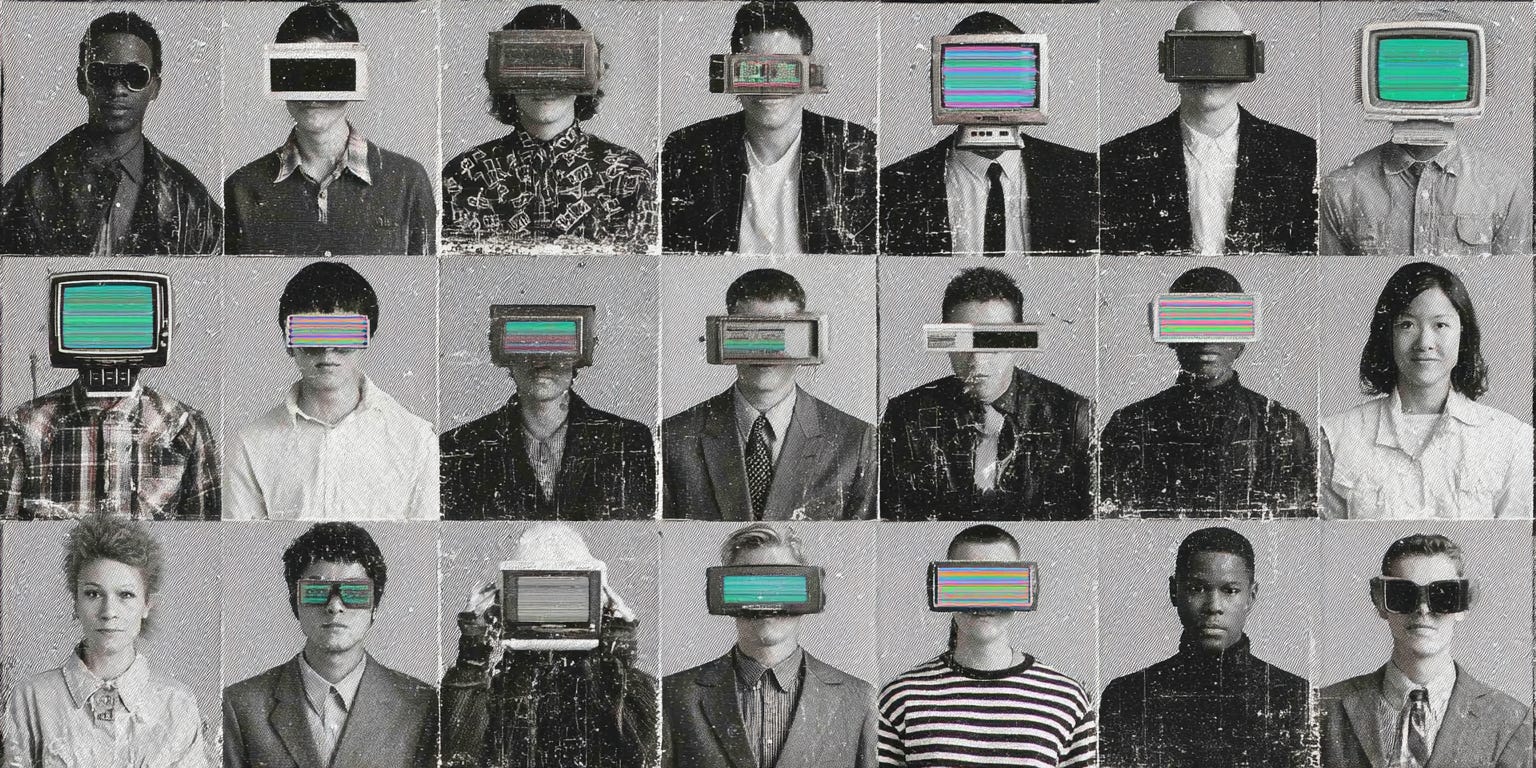
Everyone Reports to Jack
I saw an interview with Jack Dorsey last week on Brian Halligan’s Long Strange Trip podcast where he was describing the reimagination of the modern company. He described a version of the future that sounds ridiculous on its face.
“In the most ideal case, there is no layer. Everyone in the company reports to me. That would be all 6,000.”
Six thousand direct reports. Not as a metaphor. But as the literal structure of the company.
He wasn’t talking about becoming superhuman. He was talking about removing the need for management altogether. He means: management as the feedback loop between direct market interaction and decisions on what to do. The entire layer of coordination that sits between strategy and execution. The one-on-ones. The reporting structures. The system layer that turns intent into action.
If AI systems can coordinate work and if they can house the collective heartbeat of the entire living breathing organization. If there is a layer of basic analysis, judgement, and execution running all the time, 24 hours a day, 7 days a week. A machine that can track progress, route tasks, synthesize decisions, surface noise that’s just become signal. Well if that starts to happen, the historical reason for management begins to disappear entirely. And if that disappears so too does the entire apparatus to support it.
New York and Erie Railroad
The modern corporation is a relatively recent invention.
For most of human history, work was small, local, and coordinated through proximity. A merchant, a workshop, a farm. Decisions were made in real time. Information moved as fast as a conversation could travel.
That broke in the 19th century. The railroads introduced a new problem: scale. In the mid-1800s, they became the first truly large-scale enterprises. Thousands of workers spread across vast distances, operating expensive, tightly coupled systems that required precision. A single mistake could cascade across the entire network. Trains collided. Cargo was lost. Schedules broke down. The system was too complex to manage through informal communication or local judgment alone.
One of the people tasked with solving this problem was Daniel McCallum, the general superintendent of the New York and Erie Railroad. In 1855, McCallum produced what is widely considered one of the first modern organizational charts - a visual diagram beautifully mapping lines of authority and responsibility across the entire railroad, all as branches and leaves on a tree. It showed who reported to whom, how decisions flowed, and where accountability lived. More than a simple diagram, it represented a new system of organizational control.
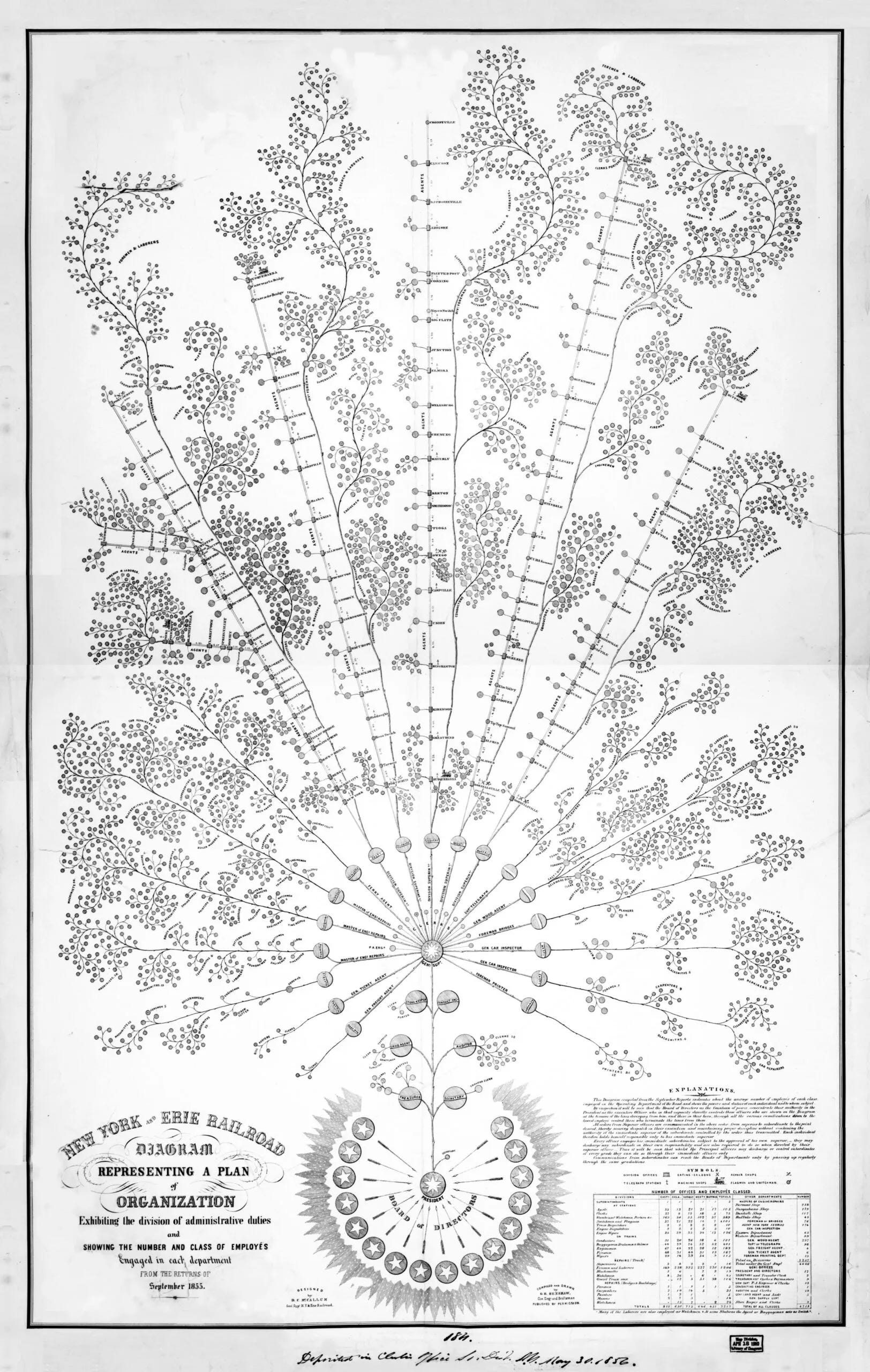
McCallum paired the chart with a set of management principles: clear division of responsibility, precise reporting, strict accountability. Simplicity and reliability were the goals. If every person knew their role, and every role fit into a broader structure, the system could operate at scale without constant breakdown.
Nearly a century later, Ronald Coase, in his groundbreaking essay “The Nature of the Firm” explained why this structure existed at all. His theory was simple: firms exist because markets are expensive to use. Every interaction is a transaction. And within every transaction is a taxing bundle that includes every decision, every negotiation, and every exchange of information, all with an implicit cost attached. Contracts must be written. Information must be gathered. Work must be orchestrated.
It’s too expensive to interact with market participants all the time. So instead of constantly negotiating with separate entities, we form companies. Companies hire people. They build process and structure. They have managers who make decisions.
The firm, in Coase’s view, is not an abstract idea. It is a solution to transaction costs. Hierarchy is what you build when coordination is expensive.

Jobs to be Done
AI is something quite unlike anything that’s come before it. It changes and challenges the basic tenets of modern organizational theory.
For most of modern business history, companies have been organized around functions - sales, marketing, finance - each a bundle of tasks performed by a human and coordinated through layers of management. But AI doesn’t map cleanly onto jobs. It maps onto tasks. In this week’s Topline, Jordan Crawford states “we built our organizations around human capabilities… AI capabilities are much different.” Tasks that once required coordination can now be handled by systems. Information that once moved slowly between people can now be synthesized instantly. What used to require multiple roles can increasingly be done by a single operator working through a set of tools.
Which means the job itself is the wrong unit of analysis. If you actually watch what people do all day: downloading reports, updating systems, moving information between tools, preparing work for someone else. If you watch you start to see how much of what we consider “work” exists only because coordination was expensive.
AI says something different. It asks “Why?”. It forces you to unbundle every role into its underlying tasks and ask which ones require judgment, which ones are mechanical, and which ones disappear entirely when the system can think across the workflow instead of inside a function.
When this happens, the entire structure is called into question. When transaction costs fall, the justification for management itself is called into question. It becomes friction. If you rebuilt the company from scratch, starting from tasks instead of titles, you wouldn’t recreate the same organization. You’d design something smaller, faster, and far less dependent on layers to hold it together.
The First Move Is Always Wrong
But how do you get there from here? Retraining and reimagining the entire structure of the company is not something that will be widely embraced, especially by old timers like me. It will feel too reactionary. Too unsettling.
The answer is definitely not give everyone an enterprise Claude license and scream “Do more AI!” every morning when you wake up. Instead, the early adopters and the organizational leaders are centralizing first.
A head of AI. A small internal team. A center of excellence responsible for tooling, workflows, and experimentation. At companies like Sendoso, this takes the form of a dedicated group running structured sprints, building agents across functions, and controlling how AI is deployed. Unsurprisingly, Kris is part of that team, a benefit of having a partner Co-CEO to handle day-to-day while he helps design, test, and set long-term organizational design and strategy.
This is the right first step.
AI is uneven. It works brilliantly in some areas and fails completely in others. Left alone, most organizations won’t use it well. They’ll apply it to the wrong problems. They’ll optimize existing workflows instead of replacing them. They will create new terribly designed hard-to-use databases from the old terribly designed hard-to-use databases they used to use.
As Jordan Crawford says, “the solution is not to give everyone access and hope for the best.”
The solution, for now, is to centralize a team to get deep firsthand experience with the tools so they can begin the task of reimagining the entirety of corporate organizational architecture.
Two Turns Instead of One
The advantage is more than cost reduction. It’s iteration speed.
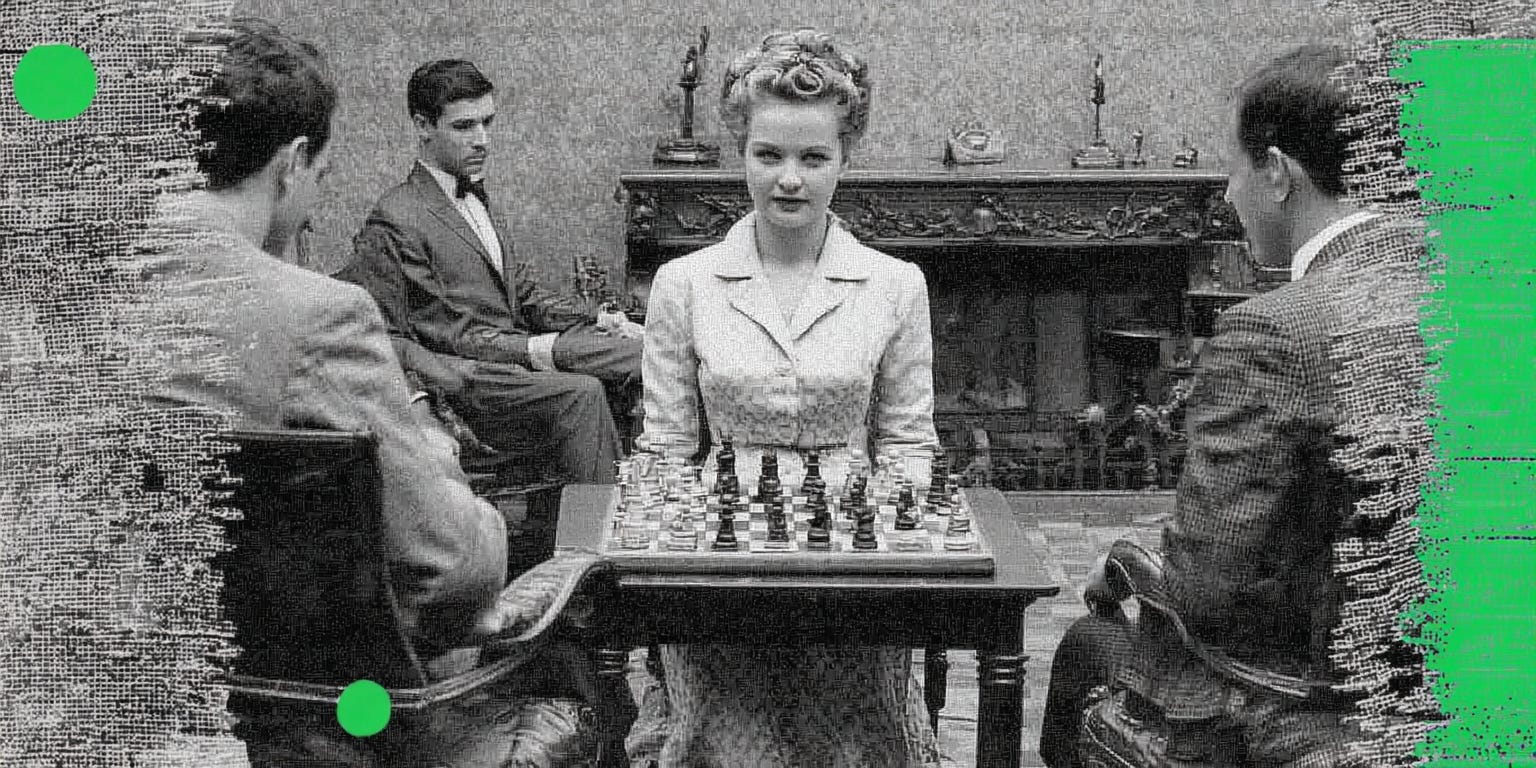
Jordan again: “You can beat any grandmaster at chess if you get two moves for every one your opponent takes.”
AI allows you to run more loops. More campaigns. More experiments. More decisions. It is the decision co-efficient embodied. Or, more accurately, emdigitized.
What used to take a week now takes a day. What used to take a day now takes an hour. The compounding effect is enormous. The companies that win will simply learn faster than everyone else. The ones that can test, refine, and redeploy continuously.
Velocity becomes the strategy.
Blocked Arteries
When you follow this logic to its conclusion, the shape of the firm evolves. Execution becomes automated. And automatic. Tasks are unbundled. Testing and Iteration accelerate. The need for coordination layers diminishes. The traditional middle, the layer responsible for translating strategy into execution, collapses. The function they served is being absorbed by systems.
What remains are two poles: on the one side, human-to-human interaction requiring authenticity, dynamism, a spark: selling, negotiating, leading, making sense of ambiguity. Orchestration on the other - designing workflows, connecting systems, directing agents. Everything in between compresses. This is what Jack Dorsey was talking about. A more polarized, more extreme version of what we used to think of as “a company.”
Which brings us to the real bottleneck. For most of modern history, companies were constrained by labor. Now they are constrained by judgment.
AI expands what is possible, but it does not tell you what matters.
In fact, it makes that question harder. Because when everything becomes easier to do, the cost of doing the wrong thing increases. Or doing the right thing very slowly.
The limitation is no longer the system. It is the imagination of the person using it. The size of the question they are willing to ask. The people who win will ask bigger questions. Questions that reframe the market, redefine the customer, or unlock entirely new surfaces of value. The people who lose will ask smaller ones. Incremental, safe, and ultimately insignificant.
Here is your fork in road. The decision point where you will either grow or perish . You will need people with creativity, judgment, and the confidence to operate without a script. People who can define the output before they know how it will be built.
Because the alternative is more dangerous than it looks. The people who keep asking small questions, who cling to familiar workflows, who use powerful systems to do trivial things. Those people become friction. The arterial blockages clogging the entire system, until the company asphyxiates under the weight of its own caution.
Central Intelligence
The org chart was designed to manage people.
The next system will be designed to concentrate judgment.
Clarity. Not authority. Not hierarchy.
A small number of operators who understand what is possible. Who define the right problems. Who set direction with precision. And who allow systems to execute at scale.
Central Intelligence.
Execution everywhere.
Judgment at the center.
For the first time in a long time, the success of the company depends less on how well it is managed, and more on how clearly it thinks.
Next Week

Untethering. Every self help book is the same. You are more than your mind. You are more than your emotions. You are more than your body. You are the one who watches. So great, we’re ready to let go. But can we retain our ambition and still find our Zen. Are they complimentary or competitive?
Also On My Mind
A few other things on my mind. Let me know what else you might like me to write about.
A great brand is willing to be different. To be different, you have to take risks. To take risks you have to be willing to piss some people off. Or be weird. But that’s what wins in this world. So do you have the cojones?
You were born to hunt. That might be the problem. Kyle Lacy reminds us that motion isn’t progress. A great quick read from the Topline newsletter (which is now on Substack btw).
Pavilion Gold and dealflow as proprietary signal. We introduced private investing into Tier 1 deals as part of Pavilion Gold. As I watch the deals come through, I’m reminded that dealflow it an incredibly valuable signal unto itself, even if you never write a check. Once you have this signal, you really don’t want to be on the outside of it.
Thanks for reading.
Sam
PS If you liked this, feel free to share it with a friend, show your phone to your spouse and yell, “See!? I was right!” at the top of your voice, reply to this email and say hi. I get all replies btw. If you like the pictures, use the Midjourney reference code --sref 962868423 to make your own. This newsletter comes out every Sunday. Unsubscribe freely for any or no reason.
Living and thinking about this every day. Notes from the field:
The Centralisation Trap (and Why It's Not Enough)
The instinct to centralise AI is right. It beats handing everyone an enterprise licence and hoping for the best. But centralisation solves the *governance* problem while quietly creating a new one: the people now responsible for AI across the business often know the least about the work being done in the functions they're supposed to serve.
Go-to-market is the clearest example of this. It's historically under-served — by technology, by internal attention, often living in its own silo. A centralised AI team looking at sales and GTM sees a black box. They get nothing useful in. Nothing useful comes out.
The Judgement Problem
To actually rethink the work with AI, you need a rare overlap: subject matter expertise in the function, first-principles thinking, genuine familiarity with AI's actual capabilities, and deep knowledge of how humans work in *that specific organisation*. Miss any one of those and you'll build something that doesn't get adopted, doesn't get used, or doesn't move towards the goal.
This is what your point lands on so cleanly: organisations used to be constrained by labour. Now they're constrained by judgement. The bottleneck has shifted inward.
What This Opens Up
The bigger questions framing is useful here — though first principles might be the more approachable way in for most people. Either way, the implication is the same: AI doesn't just change *how* work gets done. It forces a reckoning with *what the work actually is*.
This Is Still the First Step
It's worth naming that everything above is describing the earliest stage of a much longer transition. When we talk about what AI means for real work, it's easiest — and most honest — to talk about the next step, because anything beyond that, both the technology and the humans using it will have changed in ways we can't yet see clearly.
That's not a limitation of the thinking. It's a limitation of how humans conceptualise change. We anchor to what we're doing right now. The step we can see is the one directly in front of us. That's fine. It's where the work is.