Sundays with Sam #23: Attention Deficits
On distribution, LinkedIn, and the impossible work of keeping anyone’s attention

124,000
I have 124,000 followers on LinkedIn. I began posting regularly in 2022, when I had about 20,000. I worked with a now well-known LinkedIn whisperer, Alec Paul, and we set out to create a content creation machine. I wrote frequently and built a content archive that now has hundreds of posts: hot takes, “I was talking to a CRO at a $100M company” stories, listicles. The whole bit. You’ve probably rolled your eyes at one or two of them over the years.
For a long time, it worked. My follower count rose steadily. I had a few viral hits which I still have to perform at kids’ parties in the Valley between higher-profile gigs. The audience and engagement I built on LinkedIn helped support Pavilion during a period when a lot of other things stopped working.
Then the machine changed. A couple of years ago, LinkedIn labeled me “hate speech” when I poked fun at a friend. My account was subsequently throttled. Around the same time, the broader algorithm changed too. The formats and habits that worked from 2022 through 2024 began to decay. I could have kept tinkering: horizontal video, vertical video, carousels, AI-generated images, human-generated images, all the things. But the work became exhausting, and the payoff became harder to see. Now when I post, I am lucky to get more than a handful of likes and a few thousand impressions.
I have a group of people who directly expressed interest in hearing from me and yet when I write something I have no idea if any of them will see it.
If a Follower Falls in the Forest
124,000.
It sounds like reach. Like an owned audience. Like … distribution. The big D!
A large number sits under my name, and that number implies access to a market. In the language of modern business, some might call this a moat.
But a follower count is not reach. Not anymore. It is a record of prior interest. It tells you that someone once clicked a button. It does not tell you that they will see what you write, remember who you are, or care when the next post appears.
Over a hundred thousand people chose to follow me, but the platform chooses whether the relationship gets activated.
Distribution is not a moat because modern distribution is conditional access.
It is rented visibility. Permission mediated by platforms, algorithms, inboxes, feeds, filters, and the evaporation attention spans of people already drowning in too much everything.
The Algorithm Is the Landlord
Even email, the mother of all owned media channels, is unreliable. Our Topline newsletter has roughly 140,000 subscribers. When we first moved to Substack, we were seeing 50% open rates within hours of each send.
Then Google started labeling the emails as “Promotional” (which, in their defense, they sort of are). Open rates predictably fell dramatically. The content quality and the audience did not change. But our ability to reach that audience disappeared because an inbox provider moved us from one mental shelf to another.
People like to talk about owned audiences because they want to distinguish them from rented channels. The instinct is right but the idea is a fiction.
There is simply no channel that exists in the world where you can reliably reach any specific person 100% of the time.
LinkedIn can throttle reach. Gmail can filter the inbox. X can change the algorithm. The platform owns the pipe. You own a claim on a relationship that the pipe may or may not honor.
We’ve come upon the barely visible fragility of modern distribution. A company or person can spend years building a following on a platform and then discover that the platform was the asset all along. It was always better to be iTunes than the Beatles and today it’s worse than ever.
If someone else decides whether your audience sees you, you do not own distribution. You are a tenant. They are the landlord.
Attention Recessions
The modern professional lives inside a machine built to interrupt them. Digital tools were supposed to organize work. They became a second workplace inside the workplace: notifications, unread channels, infinite threads, and messages that demand urgency while rarely deserving it.
The data now says what everyone already knows in their bones. Average attention on a screen fell from roughly two and a half minutes in 2004 to roughly 47 seconds in recent years. 80% of employees cannot go a full hour without being distracted, and 59% face distractions every 30 minutes or less.
The same thing is happening outside the office. The human mind is being trained for interruption at planetary scale. OECD’s PISA research found that 65% of 15-year-olds are distracted by digital devices and a longitudinal study of more than 8,300 children found that rising social media use was associated with rising inattention symptoms.
Attention is being fragmented at the exact moment every company, creator, and founder has been told to build an audience. Or perhaps because of that fact.
Distribution Decay
Our global inability to pay meaningful attention fundamentally changes how distribution assets should be valued. An email address, a follower, a subscriber, a community member, or a podcast listener is a claim on future attention. The claim only has value if it can be converted into action. The path from audience to action runs through a sequence of gates: delivery, visibility, attention, trust, and response.
The value of an email address is not determined by one variable but many: the probability the message is delivered, the probability it lands somewhere visible, the probability it is noticed, the probability it is opened or read, the probability it is trusted, and the probability it produces action. A modest decline at each stage produces a violent decline in total value.
If inbox placement falls from 95% to 80%, true attention falls from 40% to 25%, action (ie clickthrough rates) falls from 6% to 2%, and trust falls by 20%, the resulting value does not fall by 20%. It falls by more than 80%.
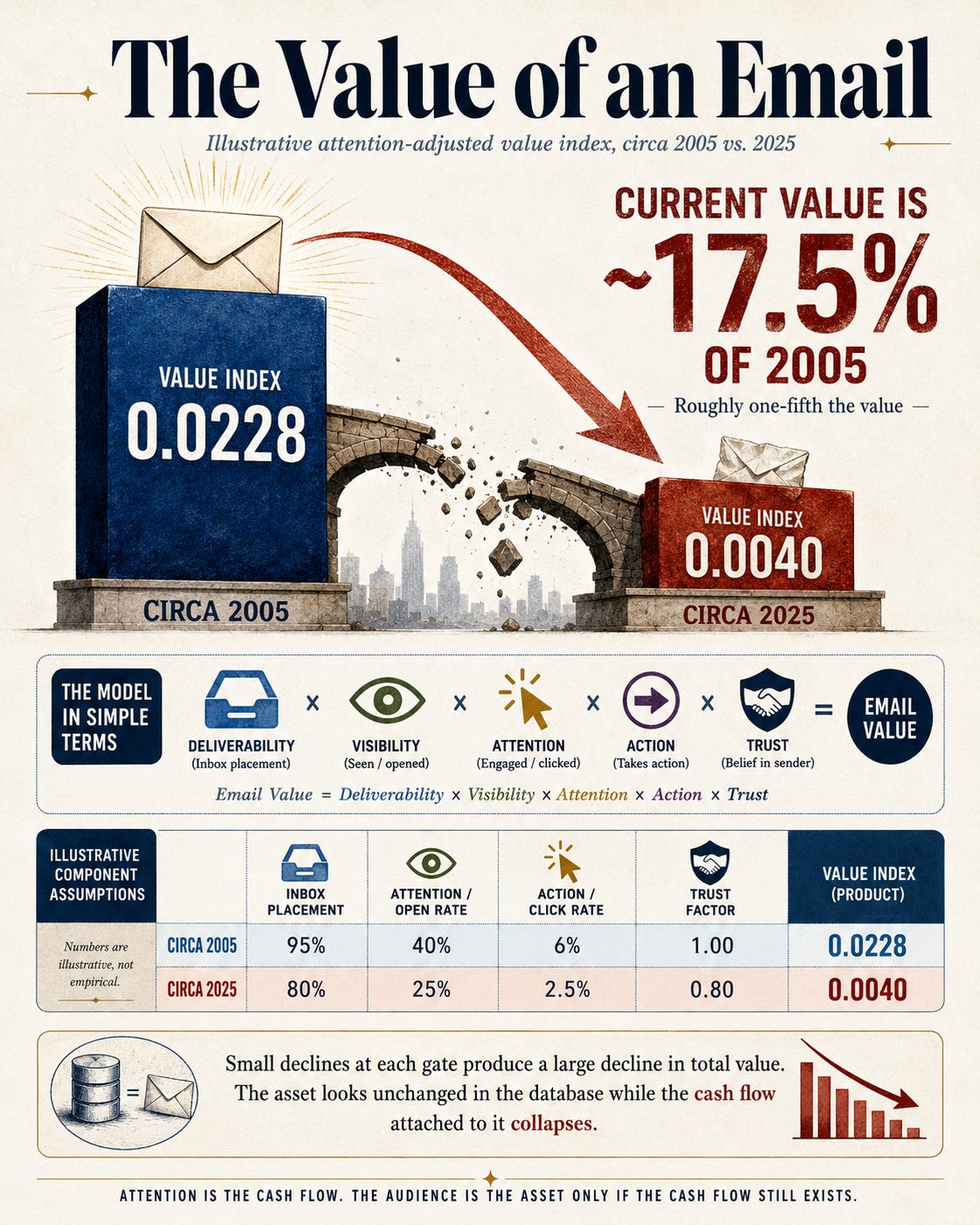
The email address still sits in the database. But the cash flow attached to that audience has been marked down by every layer of mediation, distraction, and fatigue between the sender and the recipient.
Attention is cash flow if and only if that attention is dependable, reliable, persistent. And nobody can pay attention anymore.
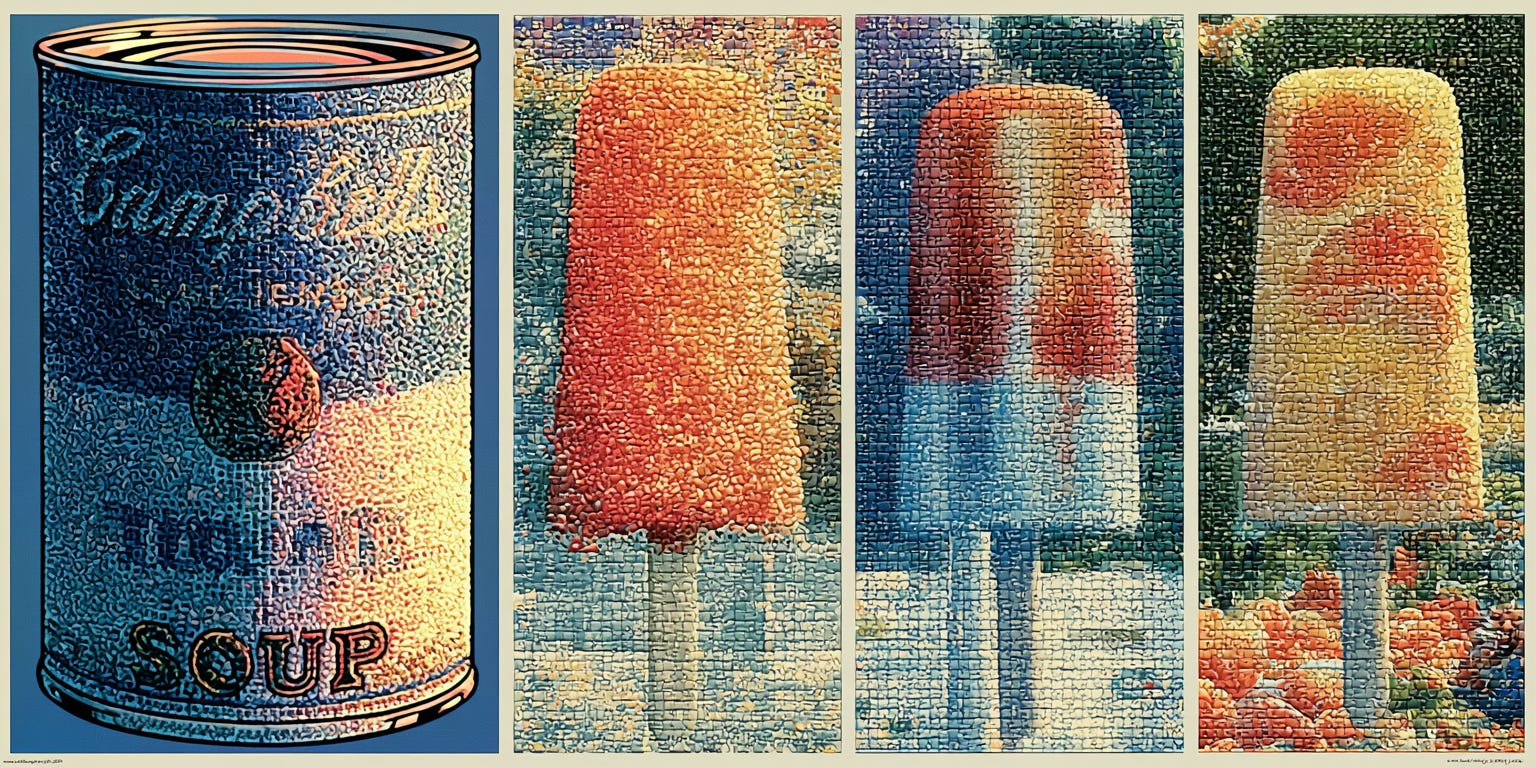
Memorizing Trust
Our goal must be to convert attention into memory and from memory into something more. Trust. Memory is the first durable residue of attention. But memory alone is not enough.
Trust is memory with a promise attached.
Trust is what happens when memory is repeatedly confirmed by experience. You said something useful and then said something useful again. You made a promise and then kept it. You showed up with taste, clarity, consistency, and restraint. You became associated with a problem, and then you kept helping people understand that problem better.
This is precisely how distribution hardens into structural advantage.
You cannot force someone to keep paying attention. You can earn a place in their mental architecture. You can become the person or company they remember when the need appears and when the choice arrives.
That is the durable asset.
Not the follower count. Or the email list. Or the podcast audience. Those are channels. Those are containers. Those are roads to the castle.
Trust is the moat.
Attention Deficits
We are living through an age of attention deficits.
Everyone is reachable, and no one is reachable. Everyone has an audience, and no one has attention. Everyone is publishing, and fewer people are truly being heard. The world is overrun by messages, and yet the messages that matter are harder to find.
This is why distribution is such a seductive false moat. It looks like power. It looks like a bridge between the company and the market. But the bridge is crowded, unstable, and controlled by toll operators who change the rules whenever they want.
The old distribution fantasy was simple: once you built the audience, you had the asset.
That fantasy is over.
The audience is not the asset. The asset is the right to be remembered. The asset is the trust that survives the feed, the inbox, and the thousand competing claims on the human mind.
Distribution can create the first moment. Attention can create the first opening. But that brief flirting attention must be converted, over time, into something far more durable. And far more powerful than the word “distribution.”
The future will not belong to the companies with the largest audiences.
It will belong to the ones people still remember when they finally need something.

Comparison Despair. The SpaceX IPO created 4,000 new millionaires and validated the idea of heavily feed SPVs as their own unique asset class. But what if it’s all your friends that got rich instead of you.? How should we process the hyper-competitive world we live in when wealth concentration and inequality seems to be exponential.
Also On My Mind
A few other things on my mind. Let me know what else you might like me to write about.
Reading the Sebastian Mallaby book about Demis Hassabis and thinking about the pursuit of a theory of everything. Demis builds AI to better understand the universe. I personally have a theory of most things but I’m not a scientist nor a philosopher. Just a collection of beliefs that hold up to our increasing understanding of the way things actually operate.
What are the new jobs of the future. Tastemaker. Experimenter. Data collector. AI Ops. What else.
Thanks for reading.
PS “Sundays with Sam” comes out every Sunday. If you liked this, feel free to share it with a friend or hit Reply to this email. I’ll see it and will likely respond. If you like the pictures, use Midjourney reference code --sref 1107080998 to make your own. Unsubscribe freely for any or no reason.
Thanks for this post, Sam. I am equally frustrated with the constant change in algorithms that control who becomes the audience. And LinkedIn is a business Facebook now filled with anniversaries, event photos creating FOMO, and, on a rare occasion, a beautiful post from a thoughtful business owner.
I would like to engage with you - please reach out to me at vicki@i95business.com, where I am rebuilding a platform to distribute meaningful content, news and connectivity among humans.
I much prefer reading you (and others) on Substack over LinkedIn; which I have drastically cut down my use of. It’s just become a mess of too much noise and inauthenticity.