Anthropocenic
The most important natural resource is us. And we're running out.

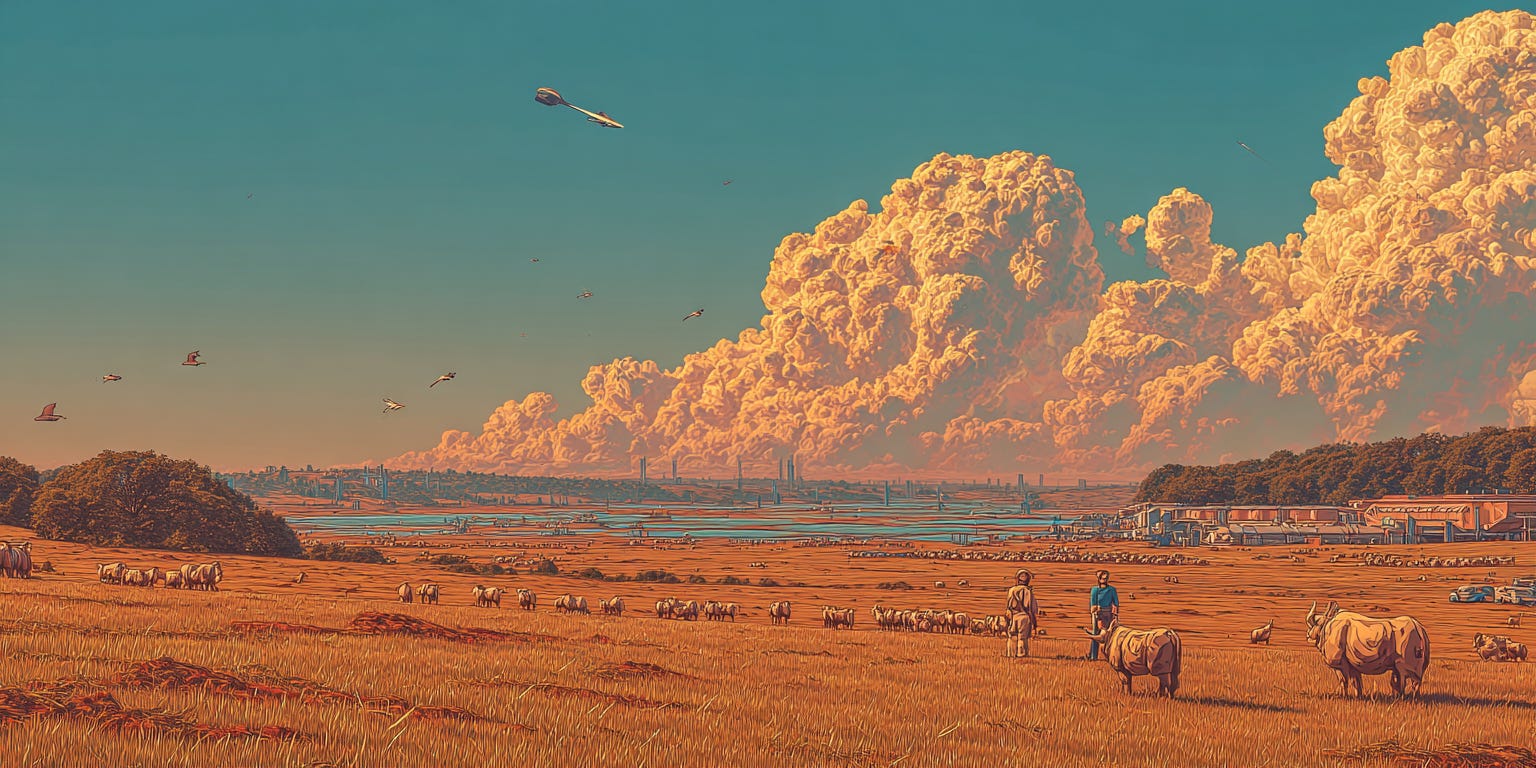
The Bet
In 1980, Julian Simon made one of the most famous wagers in modern intellectual history. Paul Ehrlich, the biologist and author of The Population Bomb, believed population growth would push the world into deeper scarcity. Ehlrich, like many pundits past and present, could only conceive of the negative implications of population growth. Like many modern environmentalists, the message was some form of:
Humans are bad. We make the world worse. The only way through our own self-created crisis is to do less. Use less. Consume less. Be … less.
Simon introduced and popularized a very different narrative. Because of supply and demand price adjustments inherent to markets, we had never and would never run out of natural resources. And contrary to Ehrlich, human population growth was a good thing.
More people generate more ideas. More substitutions. More productivity gains.
The bet itself was simple. Pick five natural resources. If Ehrlich was right, human-driven depletion would drive up the inflation-adjusted price of all five resources. If Simon was right, the opposite would happen.
Ehrlich chose five metals: tin, tungsten, nickel, chromium, copper. [ed note. wtf is chromium?] Ten years later, all five had fallen in real price. Simon won.
It is hard to overstate how much that victory shaped modern thinking. For the last forty years, the broad thrust of Simon’s argument has looked right. We have not run out of food, energy, or materials. Prices spike, but ingenuity, trade, and substitution push the frontier outward.
Human beings are not just consumers. We are creators.
More From Less
That worldview has only been strengthened in recent years. Andrew McAfee’s More from Less makes the case that advanced economies are increasingly decoupling growth from resource use. The EPA’s official greenhouse gas inventory says U.S. net greenhouse gas emissions fell nearly 20 percent over the last 20 years, even as the U.S. economy continued to grow.
The same broad story shows up in energy. Global oil demand kept rising in 2024 to 193 exajoules even as oil’s share of total energy demand fell below 30 percent for the first time in half a century. The world is still consuming enormous amounts of oil, but the economic system is becoming more diversified and less dependent on it.
Even the current shock in oil markets reinforces the larger point. Brent crude has surged in March 2026 as the U.S.-Israel war with Iran widened. But over the long run, inflation-adjusted oil prices have remained effectively constant since 1946 at roughly $58 per barrel.
So Simon was not crazy. And neither is McAfee.

Three Engines of Growth
At the highest level, there are only a few ways an economy can get bigger. It can have more people. It can have longer-lived people who remain productive. Or it can have higher output per person through productivity, capital deepening, and innovation. For a long stretch, we got all three at once.
For most of human history, that was not true. Unified growth theory describes a long Malthusian epoch in which technological gains mostly translated into larger populations, not sustained improvements in living standards.
The escape came gradually. Life expectancy rose. Population surged. Productivity compounded. Our World in Data notes that global life expectancy rose from 32 years in 1900 to 71 years by 2021. Combined with industrial productivity growth, it produced the modern economic expansion.
Fertility Falls
But if growth is partially predicated on a growing population, we have a major problem. Because in most advanced economies, the population is no longer growing. It’s already shrinking. Fertility rates across the developed world are well below the roughly 2.1 births per woman required for replacement. Globally, fertility has fallen from about 3.3 in 1990 to roughly 2.3 today, and more than half of all countries are now below replacement. The United Nations projects that population growth will slow materially over the coming decades, peak later this century, and then begin to decline.
There are many explanations for this decline. People are delaying having children as education and career timelines extend. At the same time, social preferences have shifted. In countries like South Korea, Japan, and Italy, fertility rates have collapsed to near 1.0–1.3 births per person. Even in the United States, long considered relatively resilient, fertility has dropped to historic lows.
A shrinking or stagnant population means fewer workers, fewer consumers, and slower natural demand growth. The International Monetary Fund has been explicit that aging populations and declining labor-force growth weigh directly on output, investment, and long-term economic dynamism.
If one of the fundamental inputs into growth, more people, begins to disappear, then the entire burden shifts onto productivity and lifespan. And if those do not compensate fast enough, we move into a world few of us have ever known: a deflationary death spiral.

Deflationary Death Spirals
Deflation is not simply the mirror image of inflation. Inflation reflects a system under pressure from demand. Deflation reflects a system in which demand is disappearing. When prices begin to fall persistently, behavior changes. Consumers delay purchases. Businesses cut prices to stimulate demand. This dynamic was first formalized by Irving Fisher in his theory of debt-deflation, where falling prices increase the real burden of debt, forcing households and firms to deleverage. That deleveraging reduces spending, which pushes prices down further, tightening the system on itself.
The experience of Japan over the past three decades illustrates how persistent this state can be. Following the collapse of its asset bubble in the early 1990s and amid a steadily aging and shrinking population, Japan has struggled to generate robust demand despite prolonged periods of near-zero interest rates and repeated fiscal intervention. Japan is not a failure of policy so much as a preview of a system operating without a growing base of consumers.
You can print money. You cannot print people.
The Burden on AI
If population is no longer going to do its old work, then AI has to. That is the wager hiding underneath the current frenzy. McKinsey thinks generative AI may add between $2.6 trillion and $4.4 trillion of annual value across business use cases and contribute up to 0.6 percentage points of annual labor-productivity growth through 2040. More recently, Goldman said fully adopted generative AI could raise the level of labor productivity in developed markets by around 15 percent.
These are massive numbers. They have to be. AI is not just being asked to improve workflows. It is being asked to replace a missing engine of civilization.
If AI is going to bridge demographic decline, it has to do more than save labor. It has to create enough output, enough new demand, and enough scientific progress to compensate for fewer humans.
Population Problems
This is the uncomfortable conclusion. One way or another, we must increase the number of humans in the world. If population growth is no longer doing its historical work, then something else must replace it. The optimistic case—that AI fills the gap through incremental GDP gains—seems sufficient at first glance. If global population growth turns slightly negative then AI might offset it.
But that framing is too generous. Population growth is a continuous, compounding force. AI gains, by contrast, are front-loaded and uncertain. AI projections address the supply side. They do not solve the demand problem. AI might replace workers. It does not automatically replace customers.
That is the crux of the issue. The system we built over the last two centuries was not just a machine for producing more.
It was a machine for producing more for more people.
If that second part breaks, the entire dynamic changes. Productivity has to rise faster. Lifespans have to extend further. And even then, the system risks drifting toward structural deflation.
At some point, the question becomes unavoidable: if technology cannot fully replace population growth, then the only durable solution is population itself. A civilization that stops reproducing is making a bet that software and science can carry a burden once shared with demography.
Anthropocenic
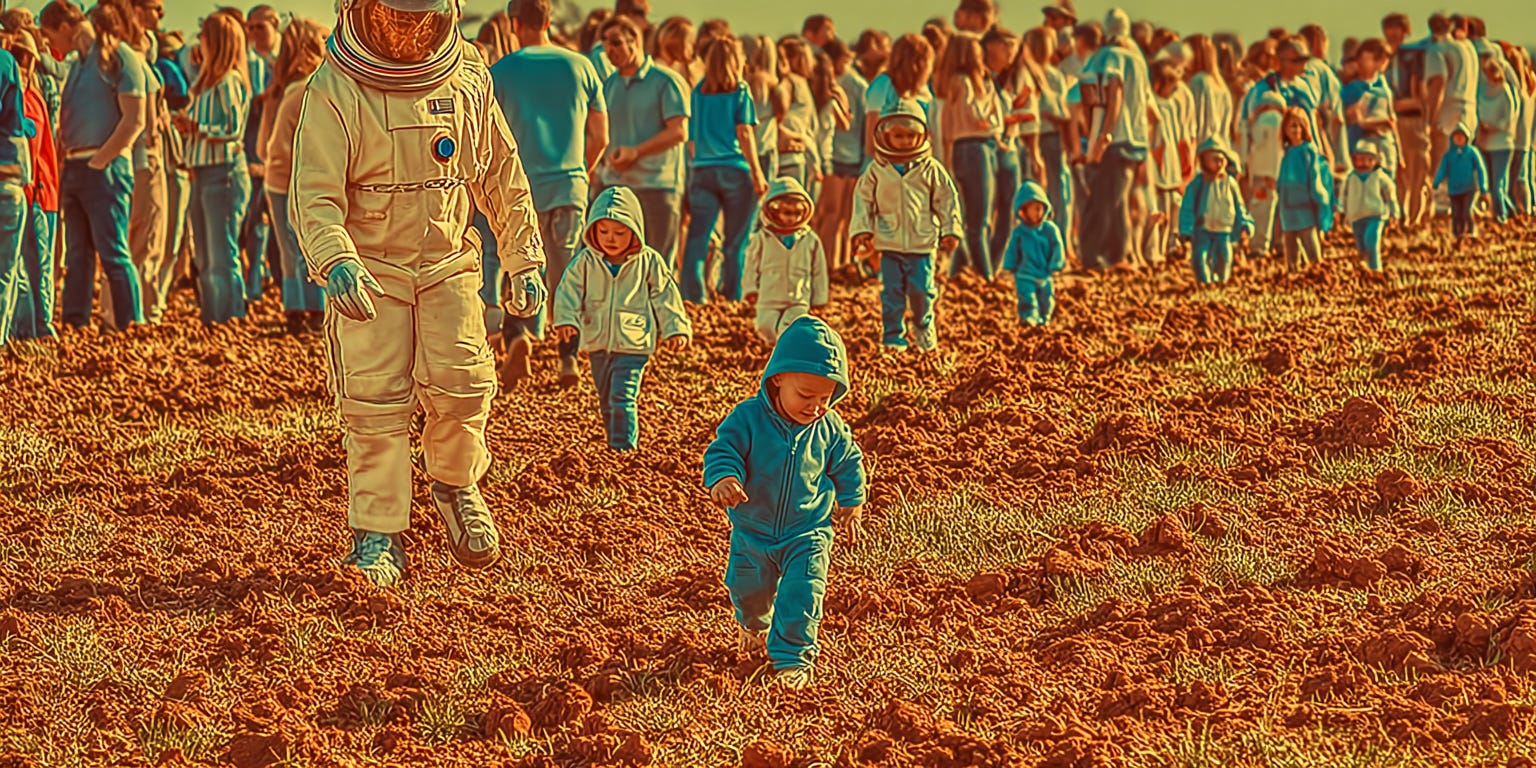
If you believe: humans are a source of abundance, more people means more ideas, more progress, and more more growth; then you arrive at an uncomfortable place. What if we actually need more humans? Not philosophically, but mechanically. We are trying the polite version of that idea now: tax credits, childcare subsidies, cultural encouragement. It isn’t working. Fertility keeps falling. If that continues, the set of responses narrows. At some point, we move from encouraging births to creating new pathways for the creation of humanity.
Systems to increase births that don’t rely on traditional family formation. And, importantly, that don’t place blame for rational choices.
It will feel unnatural. But new ideas about the structure of society are important if we are to preserve it.
The real question is what we believe. Are humans a good thing for the universe? Should consciousness expand? If yes, the conclusion is clear. We cannot accept a shrinking population and hope productivity fills the gap. We either find ways to have more children, or we build systems that do it for us.
Next Week

Focus Features. OpenAI is acquiring TBPN. Focus was doctrine. For a reason. AI doesn’t eliminate constraints. It hides them. Attention. Taste. Coherence. An AI company buying a media company feels strange and unfocused. Are all the old rules out the window? Or does having a clear strategy still matter?
Also On My Mind
A few other things on my mind. Let me know what else you might like me to write about.
The debate right now is centralized vs decentralized AI. You want the better output of a centralized AI function with in production support. But you also want to let your best athletes run and build cool stuff.
The most active conversation about AI’s impact on Go To Market right now is inside Pavilion. We’re also launching a new AI Buddy program (build AI with someone else for accountability and faster learning), a new pulse survey, and of course our AI in GTM School launching soon. If you’re interested in knowing what’s going on as it happens, take a look here.
Thanks for reading.
Sam
PS If you liked this, feel free to share it with a friend, post it online, reply to this email and say hi. If you like the pictures, use the Midjourney reference code --sref 4887071089 to make your own. This newsletter comes out every Sunday. Unsubscribe freely for any or no reason.
For a while, I did align with the "too many humans" narrative, but I've come to realize that it's a luxury believe. Species either expand or disappear, I am firmly in the expand camp now. Great article Sam, I think we'll see humanity do amazing things in even just this decade.